Executive Summary
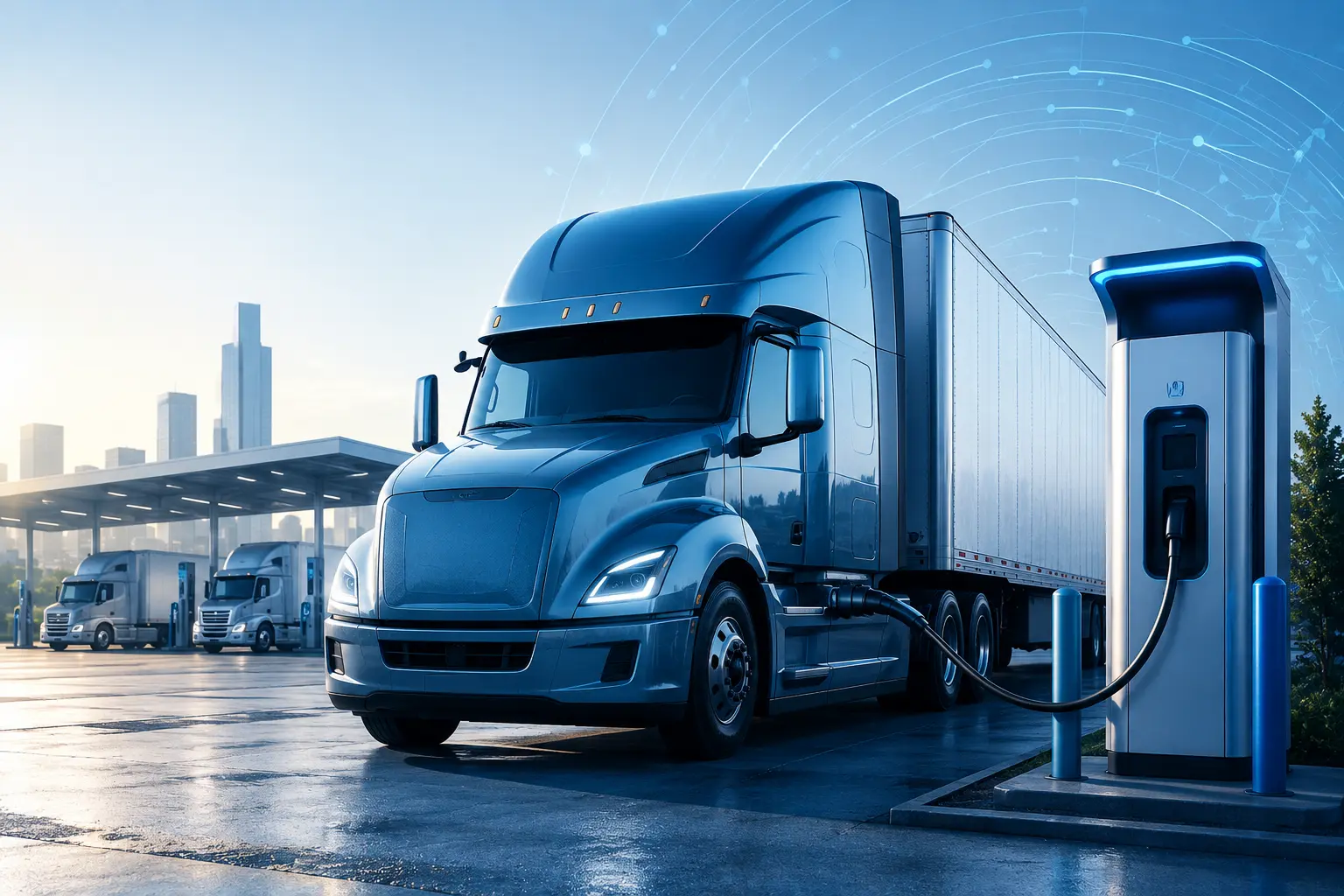
The US heavy-duty truck charging infrastructure market is at the commercial inflection point that was forecast for 2025 and has now arrived. The market is estimated at approximately US$2.2 billion in 2025 and is projected to reach approximately US$18.5 billion by 2032, expanding at a CAGR of 35–37 percent through the forecast period. Behind the headline number, three structurally important commercial milestones confirm the inflection: Tesla launched its first public Megacharger station in Ontario, California in May 2026 with a planned network of 66 sites totalling over 300 MW of installed power and 1.2 MW per stall, Forum Mobility opened the largest port-based electric truck charging depot in the US at the Port of Long Beach in January 2025 (200+ electric drayage trucks served daily), and the Megawatt Charging System (MCS 3.2) standard achieved commercial-grade deployment with the first inter-OEM interoperability tests completed in 2025.
Three forces define the trajectory through 2032. First, California's regulatory mandate has commercialised the early demand wave: the Advanced Clean Fleets (ACF) regulation requires zero-emission drayage transition with binding milestones, and parallel state-level adoption (Oregon, Washington, New York, New Jersey, Massachusetts, Maryland) is establishing a multi-state regulatory pull. Second, the operator landscape has consolidated around four distinct archetypes: pure-play heavy-duty CPOs (Forum Mobility, TeraWatt Infrastructure, Voltera, WattEV), OEM-anchored networks (Tesla Megacharger, Daimler-NextEra-BlackRock's Greenlane joint venture), traditional truck-stop converters (Pilot Flying J, Love's Travel Stops, TravelCenters of America), and utility-led programmes. Third, per-site economics are structurally different from light-duty fast charging: each heavy-duty depot consumes 5–15 MW of installed capacity (versus 0.5–2 MW for typical light-duty fast charging sites), generates US$2–8 million annual revenue at scale, and requires US$3–10 million capex — fundamentally reshaping the industry's capital allocation patterns.
For investors, fleet operators, OEMs, and policymakers, the implication is that the heavy-duty truck charging market has crossed from technology development into commercial deployment. The 2026–2028 commissioning wave — anchored by California drayage mandates, IRA Section 30C charging credits, and Tesla Megacharger network expansion — will define the operational backbone supporting the decarbonisation of the highest-emitting vehicle segment in US road transport.
Market Overview
Definition and Scope
This report scopes the US heavy-duty truck charging infrastructure market as the value chain enabling Class 7 and Class 8 commercial vehicle electrification. The scope captures: charging hardware (DC fast chargers ≥150 kW, ultra-fast chargers ≥350 kW, megawatt chargers ≥1 MW), site civil works and grid connection (transformer upgrades, switchgear, substation builds attributable to charging), software platforms (energy management, fleet routing, OCPI roaming), CPO operations (depot management, maintenance, billing), and adjacent infrastructure (on-site battery storage, solar canopy, microgrid integration). The scope excludes light- and medium-duty commercial vehicle charging (covered in the parallel US Commercial EV Fleet article), passenger vehicle infrastructure, and embedded vehicle charging hardware.
The scope captures both private depot-based charging (operated by fleet owners or third-party CPOs under contract) and public-corridor charging (open-access along freight routes), because the strategic interaction between these two modes is critical to long-haul electrification economics.
Evolution and Genesis
The US heavy-duty truck charging market evolved through three phases. The pre-2022 phase was the demonstration and pilot phase — sub-100 charge points nationally, concentrated in California port operations and OEM-led demonstrations (Daimler-Penske partnership, Volvo VNR-Electric pilots), without binding regulatory pull or commercial scale.
The 2022–2024 phase was the policy-foundation phase — the IRA's Section 30C (30 percent ITC for charging infrastructure, capped at US$100,000 per charger) and Section 45W (up to US$40,000 per commercial EV) materially altered fleet electrification economics, California finalised the Advanced Clean Fleets regulation (April 2023, effective January 2024 for drayage, phased implementation through 2045), and the first scaled depot deployments commenced (TeraWatt Rancho Dominguez, Voltera Sacramento). NEVI funding ($5 billion through 2026) was initially light-duty focused but began including heavy-duty corridor extensions in 2024.
The 2025-onward phase is the commercial deployment phase — defined by Tesla Megacharger's first public station opening in Ontario, California (May 2026), Forum Mobility's Port of Long Beach commissioning in January 2025, MCS 3.2 standardisation with multi-OEM interoperability validation, California's ACF drayage compliance milestones beginning to bite for fleet operators, and the entry of large-scale capital (Greenlane joint venture among Daimler Truck, NextEra Energy Resources, BlackRock) committing US$650 million to charging network development.
Key Market Drivers
- California Advanced Clean Fleets (ACF) regulatory mandate: Binding zero-emission drayage transition for high-priority fleets, plus phased ZEV sales targets through 2045 for medium-and-heavy-duty vehicles in California. Combined with parallel state adoption (Section 177 states under Clean Air Act), creates structural demand pull from regulatory rather than economic drivers.
- IRA Section 30C and 45W incentive stack: 30 percent investment tax credit on charging infrastructure (capped at $100,000 per charger) plus US$40,000 per commercial EV combine to reduce fleet electrification payback periods from approximately 7–8 years pre-IRA to 3–5 years post-IRA. The dual incentive structure has catalysed approximately US$15 billion in private-sector heavy-duty EV and charging investment between 2023 and 2025.
- Truck total cost of ownership crossover: Class 8 electric truck TCO at high utilisation (over 70,000 miles annually) achieved parity with diesel in 2024–2025 in California, supported by HVIP voucher (up to US$300,000 per truck), state-level charging grants, and lower diesel prices being offset by California's Low Carbon Fuel Standard pricing.
- MCS standard commercialisation: The Megawatt Charging System standard (1.0–4.5 MW per stall, ISO 15118-20 communication protocol, CCS evolution) achieved commercial-grade deployment in 2025, eliminating the standards uncertainty that delayed earlier investment. Multi-OEM interoperability tests (Daimler, Volvo, Tesla, Volvo Trucks) completed in late 2025.
Macroeconomic and Regulatory Context
The market is operating against a freight industry undergoing structural change. US Class 8 truck production approached 270,000 units in 2024, with electric Class 8 representing approximately 1.2 percent (3,200 units) — but with order books for OEM electric Class 8 production (Tesla Semi, Daimler eCascadia, Volvo VNR-Electric, Mack MD Electric, Peterbilt 579EV, Kenworth T680E) cumulatively exceeding 25,000 units through 2027. The ICCT projects medium- and heavy-duty zero-emission vehicles will require approximately 700,000 charge points nationally by 2030 to support projected ZEV adoption — implying a 175× scaling versus current installed base.
The macroeconomic backdrop is mixed. Rising interest rates (federal funds 4.5–5.0 percent in 2025) increase project finance costs, but durable IRA tax credit certainty (codified through 2032 with construction commencement before 2033) provides offsetting bankability. Utility capex is responding — projected 2025 US utility capex of approximately US$212 billion is 22 percent above 2024, partly driven by anticipated commercial vehicle charging load growth.
Market Size & Growth Outlook
US Heavy-Duty Truck Charging Infrastructure Market Size
Values shown in US$ billion (hardware, installation, software, services, network operations)
US HDV Charging Infrastructure Market Size and Cumulative Capacity
| Year | Market Size (US$ B) | Cumulative Charging Sites (HDV-capable) | YoY Market Growth (%) |
|---|---|---|---|
| 2022 | 0.4 | 120 | — |
| 2023 | 0.8 | 280 | 100.0% |
| 2024 | 1.4 | 650 | 75.0% |
| 2025 | 2.2 | 1,300 | 57.1% |
| 2026 | 3.2 | 2,400 | 45.5% |
| 2027 | 4.8 | 4,200 | 50.0% |
| 2028 | 7.0 | 6,500 | 45.8% |
| 2029 | 9.5 | 9,500 | 35.7% |
| 2030 | 12.5 | 13,000 | 31.6% |
| 2031 | 15.5 | 16,500 | 24.0% |
| 2032 | 18.5 | 20,000 | 19.4% |
The growth trajectory reflects three structurally distinct phases. Between 2022 and 2024, the market expanded at a CAGR of approximately 87 percent — a step-change driven by the IRA's enactment in August 2022, California ACF finalisation in April 2023, and the entry of dedicated heavy-duty CPO startups (Forum Mobility, TeraWatt, Voltera, WattEV). Cumulative HDV-capable charging sites grew from approximately 120 to 650, with the bulk of growth in California port-anchored drayage depots.
The 2025 inflection — moderating to 57 percent growth — reflects the transition from policy-formation to commercial-deployment phase. Three forces drove the moderation: depot capex was still approximately US$3–10 million per site (limiting deployment velocity to capital availability), truck-side electrification was approximately 1.2 percent of new Class 8 sales (limiting demand against deployed capacity), and California's HVIP voucher utilisation rate was approximately 65 percent (limiting fleet electrification velocity). Despite these constraints, 2025 marked the commercial commissioning of major Forum Mobility, Voltera, and TeraWatt depots and the Tesla Megacharger first public station.
From 2026 to 2030, the market is expected to grow at 32–50 percent CAGR with cumulative HDV-capable charging sites scaling from approximately 2,400 to 13,000. The forecast assumes (a) execution of approximately 70 percent of the announced pipeline of major CPOs (Forum, TeraWatt, Voltera, WattEV, Greenlane, Tesla Megacharger collectively committed 1,200+ sites by 2030), (b) HVIP voucher approval rate stabilising at 80–85 percent supporting fleet adoption pace, (c) IRA Section 30C extension or renewal in 2032/2033 (currently codified through 2032), and (d) continued NEVI/state grant programmes supporting public corridor charging.
The 2030–2032 trajectory shows growth moderating to approximately 20–32 percent as the first wave of major depot infrastructure completes and market value increasingly reflects operational revenue rather than deployment capex. By 2032, cumulative HDV-capable charging sites are projected at approximately 20,000 — still materially short of the ICCT's 700,000-charge-point requirement (which includes light- and medium-duty in addition to heavy-duty) but representing the operational core of US heavy-duty electrification.
A critical structural feature is the divergence between site count and revenue-per-site. Each major HDV charging depot generates 5–10× the annual revenue of a typical light-duty fast charging site (US$2–8 million versus US$0.4–1.2 million), reflecting the substantially higher energy throughput per session. Combined with longer multi-year fleet contracts that anchor utilisation, the HDV charging segment provides materially more durable revenue than public light-duty charging — a feature that has attracted infrastructure-style capital (BlackRock, KfW IPEX-Bank, sovereign wealth funds) that has historically avoided light-duty charging.
Cumulative investment across 2025–2032 is expected to exceed US$58 billion, including approximately US$32 billion in CPO project capex (depot hardware, installation, grid connection), US$8 billion in transmission and distribution infrastructure attributable to HDV charging load, US$10 billion in utility-led grid upgrades, US$5 billion in software platforms and energy services orchestration, and US$3 billion in domestic manufacturing capacity expansion (charging hardware, transformer manufacturing, switchgear).
Market Segmentation
By Charger Power Class
By Charger Power Class (Cumulative Installed, 2025)
- DC Fast (150–349 kW)42%
- DC Ultra-Fast (350–999 kW)38%
- Megawatt (1.0–4.5 MW)18%
- Multi-Megawatt (over 4.5 MW)2%
By Charger Power Class
| Segment | Description | Share (%) |
|---|---|---|
| DC Fast (150–349 kW) | Standard DC fast for light-Class 7 and slower-charge Class 8 use cases; CCS Type 1 / NACS connectors | 42% |
| DC Ultra-Fast (350–999 kW) | High-power for Class 8 daily-cycle and regional distribution; CCS / NACS dual standard | 38% |
| Megawatt (1.0–4.5 MW) | MCS 3.2 standard for long-haul Class 8; Tesla Megacharger 1.2 MW reference deployment | 18% |
| Multi-Megawatt (over 4.5 MW) | Future-state ultra-megawatt; emerging research deployments | 2% |
The power-class distribution reflects the early-stage commercialisation of MCS. DC fast (150–349 kW) and DC ultra-fast (350–999 kW) collectively account for 80 percent of installed capacity in 2025 because most Class 8 electric trucks deployed before 2025 (Volvo VNR-Electric, early Daimler eCascadia, Mack MD Electric) use CCS Type 1 connectors at maximum power of approximately 350 kW. The MCS segment (1.0–4.5 MW, 18 percent share) is the fastest-growing — Tesla Megacharger's 1.2 MW reference deployment, plus the WattEV-Tesla MCS partnership and Greenlane MCS hub plans, are commissioning at scale through 2026.
The structural shift toward MCS is irreversible. As Tesla Semi production scales to its 50,000-unit-annual target by 2027 (currently approximately 7,500 units annually) and Daimler eCascadia, Volvo VNR-Electric, Peterbilt 579EV adopt MCS-compatible charging, MCS share is projected to exceed 50 percent of installed capacity by 2030 and approach 70 percent by 2032. The implication for CPO economics is significant: MCS sites generate 3–4× the energy throughput of CCS-only sites (1.2 MW × 30 minutes = 600 kWh per session versus 350 kW × 45 minutes = 260 kWh), supporting 5–8× higher revenue per stall.
The emerging multi-megawatt segment (over 4.5 MW, 2 percent share) is currently confined to research deployments and pilot projects, with potential for long-haul truck ultra-fast charging (15-minute meal-stop charging cycles). Commercial scale is projected for 2028–2030.
By Use Case / Operational Pattern
By Use Case / Operational Pattern (Energy Throughput, 2025)
- Drayage (Port-to-Warehouse)32%
- Regional Distribution (200–400 mile loops)28%
- Last-Mile Delivery (Class 6–7)18%
- Long-Haul Corridor (over 400 mile routes)12%
- Urban / Municipal / Refuse7%
- Specialty (Yard tractors, terminal trucks)3%
By Use Case / Operational Pattern
| Segment | Description | Share (%) |
|---|---|---|
| Drayage (Port-to-Warehouse) | Short-haul port operations, 50–150 mile daily loops, fixed routes; California port concentration; ACF mandate primary | 32% |
| Regional Distribution | 200–400 mile predictable routes, depot-to-depot; first commercially viable Class 8 segment | 28% |
| Last-Mile Delivery (Class 6–7) | Amazon, FedEx, UPS, Walmart commercial delivery fleets; depot charging anchored | 18% |
| Long-Haul Corridor (over 400 miles) | Class 8 inter-state routes; requires public MCS corridor charging | 12% |
| Urban / Municipal / Refuse | Garbage trucks, municipal fleets; predictable urban routes; depot charging | 7% |
| Specialty | Yard tractors, terminal trucks, mining, port equipment; private depot only | 3% |
Drayage operations dominate the heavy-duty charging market at 32 percent of energy throughput, reflecting California's regulatory pull and the structural fit of short-haul port operations with electric trucks. The drayage segment combines short daily ranges (50–150 miles), predictable routes (port-to-warehouse fixed cycles), and concentrated geography (Long Beach, Los Angeles, Oakland, NY/NJ ports together account for approximately 65 percent of US drayage activity) — making it the most economically and operationally viable segment for early electrification. California's ACF regulation requires that drayage trucks registered after January 2024 be zero-emission, and the entire registered drayage fleet must be ZEV by 2035, creating binding regulatory demand that has directly catalysed the 2025 commissioning wave (Forum Mobility Port of Long Beach, Voltera Long Beach + Sacramento, TeraWatt Rancho Dominguez).
Regional distribution (28 percent share) is the second-largest segment and structurally important because it represents the largest scaling opportunity. Class 8 trucks operating 200–400 mile predictable routes (depot-to-depot, distribution centre operations) achieve the cleanest TCO economics at sub-US$200 per kWh battery prices because the route predictability supports depot-anchored charging without requiring public corridor infrastructure. Major regional distribution fleet electrification commitments include Schneider National, US Foods, Sysco, PepsiCo, Anheuser-Busch, and Walmart — collectively representing approximately 40,000 Class 8 trucks targeted for electrification by 2030.
Long-haul corridor operations (12 percent share) is the most challenging segment. The combination of long routes (over 400 miles), tight delivery windows, and unpredictable charging demand requires public MCS infrastructure that does not yet exist at scale. The Tesla Megacharger network expansion (66 sites planned), the Greenlane joint venture's announced 50+ corridor sites, and the Pilot Flying J / Love's Travel Stops conversion programmes are positioning to address the gap, but commercial scale is expected only post-2027. The implication is that long-haul electrification will lag regional and drayage electrification by approximately 3–4 years.
Last-mile delivery in Class 6–7 vehicles (18 percent share) is a related but distinct segment. Amazon's 100,000 EV vans (Rivian-built EDV), FedEx commitment to 100 percent EV pickup-and-delivery by 2040, UPS, and Walmart fleet electrification represent meaningful charging infrastructure demand, anchored to depot operations rather than public corridor.
By Operator Type
By Operator Type (Charge Site Share, 2025)
- Pure-Play Heavy-Duty CPOs32%
- OEM-Anchored Networks (Tesla, Daimler-Greenlane)22%
- Truck-Stop Converters (Pilot, Loves, TA)18%
- Fleet-Owned Captive16%
- Utility-Led / Municipal8%
- Port Authority / Government4%
By Operator Type
| Segment | Description | Share (%) |
|---|---|---|
| Pure-Play Heavy-Duty CPOs | Forum Mobility, TeraWatt Infrastructure, Voltera, WattEV; specialised port and depot deployments | 32% |
| OEM-Anchored Networks | Tesla Megacharger (66 sites planned, 300+ MW), Greenlane (Daimler-NextEra-BlackRock JV, $650M committed) | 22% |
| Truck-Stop Converters | Pilot Flying J + GM/EVgo (500 locations), Love's Travel Stops, TravelCenters of America converting truck stops | 18% |
| Fleet-Owned Captive | Schneider, US Foods, Walmart, Sysco operating private depot charging for own fleet | 16% |
| Utility-Led / Municipal | PG&E, SCE, ConEdison, ComEd, Duke programmes for fleet customers; municipal fleet charging | 8% |
| Port Authority / Government | Port of Long Beach, Port of Los Angeles, Port of Oakland, NY-NJ Port Authority infrastructure | 4% |
The competitive landscape is defined by four distinct strategic archetypes. Pure-play heavy-duty CPOs (32 percent share) — Forum Mobility, TeraWatt Infrastructure, Voltera, WattEV — pioneered the commercial deployment model. Forum Mobility's Port of Long Beach depot (commissioned January 2025, serves 200+ daily drayage trucks) is the largest single operational HDV charging facility in the US. TeraWatt's Rancho Dominguez facility (7 MW capacity, 20 stalls, 125 trucks/day) demonstrates the unit economics of scale. Voltera operates depots at Ports of Long Beach and Sacramento and received US$50 million from KfW IPEX-Bank in 2025 for continued expansion. WattEV operates depots in California and is partnering with Tesla on Megacharger integration plus its own truck-as-a-service model.
OEM-anchored networks (22 percent share) is the fastest-growing segment, driven by Tesla Megacharger's commercial launch and the Greenlane joint venture. Tesla Megacharger's 66 planned sites with 300+ MW combined installed power represents the most ambitious single-operator buildout. Tesla has confirmed Texas (19 sites planned) and California (17 sites) as leading deployment states, with each Megacharger stall priced at US$188,000 and using MCS 3.2 standard with ISO 15118-2 and OCPI open protocols (preserving multi-OEM compatibility). The Greenlane joint venture (announced 2023, Daimler Truck + NextEra Energy Resources + BlackRock Renewable Power) has committed US$650 million to develop 50+ public charging hubs along major freight corridors, with first sites commissioning in 2025–2026 in Southern California and on I-15.
Truck-stop converters (18 percent share) is structurally important because it leverages existing truck-stop real estate. Pilot Flying J's partnership with General Motors and EVgo announced in late 2022 targeted 500 locations with 350 kW chargers; Love's Travel Stops, TravelCenters of America, and emerging operators are pursuing similar conversions. The strategic logic is clear: truck stops have existing land, electrical infrastructure (often 11+ kV connections), driver amenities, and customer flow — overcoming the time-consuming permitting and grid-connection processes that pure-play CPOs face. However, MCS-grade upgrades to existing truck stops require substantially more grid capacity (5–15 MW per site versus 1–2 MW for fuel pumps) creating execution complexity.
Fleet-owned captive (16 percent share) deployments are concentrated at major fleet operators with sufficient scale to justify private infrastructure investment. Schneider National, US Foods, Sysco, PepsiCo, Anheuser-Busch, Walmart, and Amazon Flex are operating private HDV depot charging at scale. The captive model achieves the highest utilisation (60–80 percent) but requires fleet operators to take on charging-infrastructure operations — a capability that most have outsourced to third-party CPOs as scale increases.
By State / Geography
By State (HDV-Capable Charging Site Concentration, 2025)
By State (HDV-Capable Charging Site Concentration, 2025)
| State | Description | Share (%) |
|---|---|---|
| California | ACF mandate, Ports of Long Beach + Los Angeles + Oakland; HVIP voucher up to $300K/truck; concentrated drayage demand | 48% |
| Texas | Tesla Megacharger lead state (19 sites planned); growing Class 8 corridor deployment along I-10, I-35, I-45 | 12% |
| New York | Section 177 ACF adoption; NYC port operations; Hudson Valley distribution corridor | 7% |
| New Jersey | Newark/Elizabeth port concentration; ACF adoption; Northeast freight gateway | 6% |
| Washington | Port of Seattle/Tacoma; Section 177 ACF adoption; I-5 corridor | 5% |
| Oregon | Port of Portland; I-5 corridor; Section 177 ACF adoption | 4% |
| Illinois | Chicago freight hub; Class 8 distribution centre concentration | 4% |
| Massachusetts | Section 177 ACF adoption; Boston-Worcester distribution | 3% |
| Maryland | Port of Baltimore; Mid-Atlantic distribution corridor | 3% |
| Others | Florida, Georgia, Pennsylvania, Ohio, Arizona, Colorado, Nevada, Virginia | 8% |
California's 48 percent share reflects the convergence of three structural factors that no other state matches. First, the Advanced Clean Fleets regulation creates binding regulatory pull — drayage fleets registered after January 2024 must be zero-emission, and the full state drayage fleet must be ZEV by 2035. Second, California's port infrastructure (Long Beach + Los Angeles + Oakland combined) handles approximately 35 percent of US container imports, concentrating drayage demand. Third, California's policy stack — HVIP voucher (up to US$300,000 per truck), Low Carbon Fuel Standard credits for electric truck operations, state-level charging grants — makes electric Class 8 economics commercially viable. The combination has made California the global laboratory for heavy-duty electrification.
Texas (12 percent share) is the second-largest market and the fastest-growing. Tesla's selection of Texas (19 Megacharger sites planned) reflects multiple factors: Tesla Semi production at Nevada (Reno) supplies primarily Texas-based fleets, abundant electricity availability and competitive pricing, lighter regulatory burden than California, and major freight corridors (I-10, I-35, I-45) with high commercial vehicle traffic. Texas's growth is structurally important because it demonstrates that heavy-duty electrification can scale beyond California's regulatory mandate environment.
The Section 177 states (New York, New Jersey, Washington, Oregon, Massachusetts, Maryland, plus Connecticut, Rhode Island, Vermont, Colorado, New Mexico, Delaware, and the District of Columbia) collectively account for approximately 22 percent of HDV charging deployment. These states have adopted California's Advanced Clean Fleets and Advanced Clean Trucks regulations, creating a coordinated multi-state ZEV mandate that affects approximately 35 percent of US heavy-duty truck registrations. The implication is that the regulatory cluster effect extends well beyond California, supporting a larger addressable market for HDV charging than California's mandate alone implies.
By Charging Connector / Standard
By Charging Standard (Installed Capacity, 2025)
- CCS Type 156%
- MCS 3.2 (1.0+ MW)22%
- NACS / J340014%
- Multi-Standard (CCS + MCS or NACS + MCS)8%
By Charging Standard / Connector
| Standard | Description | Share (%) |
|---|---|---|
| CCS Type 1 | Existing standard for non-Tesla Class 8 EVs; Volvo VNR-Electric, early Daimler eCascadia, Mack MD Electric | 56% |
| MCS 3.2 (1.0+ MW) | Megawatt Charging System; Tesla Megacharger reference deployment; multi-OEM interoperability validated 2025 | 22% |
| NACS / J3400 | North American Charging Standard (Tesla-derived); broader adoption post-2025 transition; SAE J3400 standardisation | 14% |
| Multi-Standard | Sites supporting multiple connectors via dual-cable hardware; future-proof deployment | 8% |
CCS Type 1 currently dominates at 56 percent share, reflecting the installed base of pre-2025 deployments. The structural shift toward MCS is well underway: MCS 3.2 share grew from sub-5 percent in early 2025 to 22 percent by year-end, and is projected to exceed 50 percent by 2028. The NACS transition (14 percent share, growing) is following the parallel light-duty NACS adoption curve, with Tesla's Megacharger dual-supporting NACS and MCS configurations to enable cross-OEM compatibility.
The structural advantage of MCS is operational: a 1.2 MW MCS session adds approximately 60 percent of range to a Tesla Semi in 30 minutes, versus 80–120 minutes at CCS 350 kW for equivalent range gain — a difference that materially impacts driver duty-cycle utilisation. Multi-OEM interoperability (validated through Tesla's adoption of MCS 3.2 with ISO 15118-2 and OCPI open protocols) eliminates the fragmentation risk that plagued early heavy-duty deployment.
Trends & Developments
Tesla Megacharger Commercial Launch as the Industry Inflection Point
The first public Tesla Megacharger station opening in Ontario, California in May 2026 marks the industry's transition from technology development to commercial deployment. Tesla's 46-site initial buildout (announced Spring 2025) expanded to 66 planned sites by year-end, with Texas (19 sites) and California (17) leading. Each Megacharger stall delivers up to 1.2 MW power and is priced at US$188,000 — establishing a hardware cost benchmark that competing CPOs will need to approach for sustainable competition. The strategic implication is significant: Tesla's vertical integration (Tesla Semi production + Megacharger network + WattEV truck-as-a-service partnership) creates a fleet-electrification ecosystem that competitors must respond to either through similar integration or specialised differentiation.
The shift toward Tesla-style BEV truck integration has come at the cost of FCEV-positioned and standalone HDV-startup competitors. Nikola Corporation filed Chapter 11 bankruptcy protection in February 2025 after its hydrogen fuel-cell semi-truck programme failed to scale — cumulative deliveries reached only several hundred vehicles against multi-thousand initial commitments — and Hyzon Motors disclosed going-concern qualifications in its 2024 financial statements. The cautionary implication is that HDV charging infrastructure capital is increasingly anchored to BEV-positioned OEMs (Daimler Truck, Volvo, PACCAR, Tesla, plus Chinese BYD) rather than diversified BEV/FCEV portfolios. Infrastructure-side investment thesis now rests on truck-OEM execution, not on technology-pathway optionality — a structural shift that materially benefits the depot-anchored MCS deployment model over distributed hydrogen refuelling alternatives.
MCS Standardisation and Multi-OEM Interoperability
The Megawatt Charging System achieved commercial-grade standardisation in 2025 with multi-OEM interoperability tests completing among Daimler, Volvo, Tesla, and other major manufacturers. The MCS 3.2 specification (1.0–4.5 MW power range, ISO 15118-20 communication, CCS evolution) now supports cross-OEM charging at any compliant station — eliminating the "charge anywhere" anxiety that constrained earlier fleet electrification decisions. The forward implication is that the addressable installed base for any single MCS station grows materially as the cross-OEM electric fleet scales, supporting better unit economics than would be possible with proprietary standards.
California Drayage Electrification Pulling Forward Demand
California's Advanced Clean Fleets regulation, with binding drayage transition starting January 2024, has effectively front-loaded heavy-duty charging demand. The high-priority fleet rules require drayage trucks registered after January 2024 to be zero-emission, with the full registered drayage fleet of approximately 33,000 vehicles required to be ZEV by 2035. The transition timeline has compressed fleet electrification decisions and triggered the 2024–2026 deployment wave concentrated at California ports. The implication for the broader market is that California serves as the operational laboratory — successful deployment patterns (Forum Mobility's Port of Long Beach, TeraWatt Rancho Dominguez, Voltera Long Beach) provide replicable templates for similar deployments in other ACF-aligned states (NY, NJ, WA, OR, MA, MD).
Greenlane Joint Venture and Infrastructure-Style Capital Entry
The Greenlane joint venture among Daimler Truck, NextEra Energy Resources, and BlackRock Renewable Power (announced 2023, US$650 million committed) represents the entry of infrastructure-style institutional capital into heavy-duty charging. The joint venture's strategic logic combines OEM-side demand certainty (Daimler's commitment to electrify a substantial portion of its truck output by 2030), utility-side operational expertise (NextEra), and infrastructure-style capital scale and patience (BlackRock). The 50+ planned hub sites along major freight corridors, with first sites commissioning in 2025–2026 in Southern California and along I-15, anchor the infrastructure-style investment thesis. The forward implication is that additional joint ventures combining OEMs, utilities, and institutional capital are likely — heavy-duty charging is increasingly viewed as a long-duration infrastructure asset class.
Truck-Stop Conversion as Strategic Real Estate Play
The conversion of existing truck stops to support heavy-duty charging is emerging as a distinct strategic play. Pilot Flying J (with General Motors and EVgo) targeting 500 locations, Love's Travel Stops, and TravelCenters of America are advancing parallel conversion programmes. The strategic logic — existing real estate, electrical infrastructure, driver amenities, and customer flow — overcomes the permitting and grid-connection challenges that pure-play CPOs face. However, MCS-grade upgrades to existing truck stops require substantially more grid capacity (5–15 MW per site versus 1–2 MW for fuel pumps), creating execution complexity that has slowed implementation versus initial announcements. The forward implication is that truck-stop conversions will accelerate post-2026 as utility-side grid upgrade processes mature and the parallel light-duty NEVI deployment provides operational experience.
Utility Rate Design and Demand-Charge Innovation
Utility rate design is emerging as a critical economic determinant of HDV charging viability. Traditional commercial demand-charge structures (where peak power demand drives a substantial portion of monthly bills) make HDV charging economically challenging — a depot operating at 5 MW peak load can incur US$30,000–80,000/month in demand charges alone, substantially exceeding energy costs. Utility innovation is responding: PG&E, Southern California Edison, ConEdison, and ComEd have introduced HDV-specific tariffs that flatten or eliminate demand charges in exchange for time-of-use load management. The implication is that utility-side rate design innovation is now a key bankability factor for HDV charging projects, and CPOs with strong utility relationships (Tata Power-equivalent positioning) have structural advantage.
Competitive Landscape
US HDV Charging Competitive Landscape (Estimated Site Share, 2025)
US HDV Charging Competitive Landscape — Strategic Posture
| Company | Strategic Posture | Share (%) |
|---|---|---|
| Tesla Megacharger | Vertically integrated network; 66 planned sites with 300+ MW; first public station Ontario CA May 2026; 1.2 MW per stall, MCS 3.2; supports non-Tesla via ISO 15118-2 and OCPI | 14% |
| Forum Mobility | Largest port-based depot operator; Port of Long Beach commissioned January 2025 serving 200+ daily drayage trucks; aggressive California drayage focus | 11% |
| TeraWatt Infrastructure | Specialised heavy-duty CPO; Rancho Dominguez 7 MW / 20 stalls / 125 trucks per day; expanding to corridor and depot sites | 10% |
| Voltera | Port-anchored deployments at Long Beach and Sacramento; $50M from KfW IPEX-Bank for expansion; specialised drayage and Class 8 focus | 9% |
| Greenlane | Daimler-NextEra-BlackRock JV; $650M committed; 50+ corridor hub sites planned; infrastructure-style capital structure | 8% |
| WattEV | Truck-as-a-service plus charging hybrid model; ordering Tesla Semis; building 100 charging stations by 2035 including Tesla Gen-IV chargers | 7% |
| Pilot Flying J + EVgo | Truck-stop conversion via GM partnership; 500 locations targeted with 350 kW chargers; primarily light-duty with HDV-capable extensions | 7% |
| Love's / TA Travel Centers | Truck-stop conversion programmes; smaller scale than Pilot but accelerating; corridor-anchored strategic positioning | 5% |
| Fleet-Owned Captive | Schneider, US Foods, Walmart, Sysco, PepsiCo, Anheuser-Busch operating private depot charging for own fleet | 14% |
| Utility / Municipal | PG&E, SCE, ConEdison, ComEd, Duke programmes for fleet customers plus municipal fleet charging | 8% |
| Others | Emerging pure-play CPOs (PowerFlex, EnTech), state-DOT-managed sites, port authority direct deployment | 7% |
The competitive landscape shows a market in early-stage commercial deployment with structural fragmentation. The top 6 operators control approximately 59 percent of installed HDV-capable charging sites, with the remaining share distributed across truck-stop converters, fleet-owned captive, utility-led, and emerging operators.
Tesla Megacharger (14 percent share) leads through vertical integration. The combination of Tesla Semi production, Megacharger network deployment, and the WattEV partnership creates a fleet-electrification ecosystem that competitors must respond to. Tesla's MCS 3.2 implementation with ISO 15118-2 and OCPI open protocols means the Megacharger network is functionally compatible with non-Tesla MCS-equipped trucks — though Tesla's commercial pricing strategy and access policies for non-Tesla customers remain to be observed in operation.
Pure-play heavy-duty CPOs (Forum Mobility, TeraWatt, Voltera, WattEV — collective 37 percent share) have pioneered the commercial deployment model and dominate the early port and depot deployment segment. Forum Mobility's Port of Long Beach depot is the largest single operational HDV charging facility in the US, and TeraWatt's Rancho Dominguez facility demonstrates the unit economics of scale (7 MW capacity, 20 stalls, 125 trucks/day). The strategic positioning of these specialised operators emphasises depth in heavy-duty operations, fleet contracting expertise, and grid-integration capability.
Greenlane (8 percent share, growing) represents the entry of infrastructure-style institutional capital into HDV charging. The Daimler-NextEra-BlackRock joint venture's US$650 million commitment and 50+ planned corridor hub sites positions it as the principal corridor-charging operator in competition with Tesla Megacharger.
Truck-stop converters (Pilot Flying J + EVgo, Love's, TA — collective 12 percent share) are leveraging existing infrastructure to enter the market. The Pilot Flying J + GM + EVgo partnership targeting 500 locations with 350 kW chargers is the largest single conversion programme, but most of the 500 locations are primarily light-duty with HDV-capable extensions rather than dedicated MCS deployment.
Fleet-owned captive (14 percent share) deployments are concentrated at major fleet operators with sufficient scale to justify private infrastructure investment. Walmart, Schneider National, US Foods, Sysco, PepsiCo, and Anheuser-Busch operate private HDV depot charging at scale. The captive model achieves the highest utilisation but requires fleet operators to take on charging-infrastructure operations — a capability that most have outsourced to third-party CPOs as scale increases.
The forward competitive dynamic is expected to consolidate around three to four major operators by 2030 — Tesla Megacharger, Greenlane, the leading pure-play CPO (likely Forum Mobility through scale or Voltera/TeraWatt through M&A), and the leading truck-stop converter (likely Pilot Flying J via the EVgo + GM partnership) — with the remaining share distributed across regional specialists, utility programmes, and captive deployments.
Challenges & Opportunities
Key Challenges
Grid Capacity and Connection Timeline Constraints
The most binding operational constraint on HDV charging deployment is grid connection. A typical HDV charging site requires 5–15 MW of installed capacity — equivalent to a small commercial substation — and grid connection backlogs in California, Texas, and the Northeast extend 12–30 months for large interconnection requests. Utility-side capex programmes are responding (US utility capex projected at US$212 billion in 2025, up 22 percent year-over-year) but the lag between charging-demand growth and grid capacity deployment is the principal constraint on deployment velocity. The implication is that HDV charging projects are coupled to utility-side modernisation, and the combined critical path from financial close to commissioning extends to 24–48 months for major depot deployments.
Truck Production Pacing and Demand-Side Risk
Class 8 electric truck production at major OEMs is scaling slower than initial projections. Tesla Semi production reached approximately 7,500 units annually in 2025 against the 50,000-unit annual target by 2027; Daimler eCascadia, Volvo VNR-Electric, and Mack MD Electric collectively produced approximately 4,500 units in 2025. The implication for charging infrastructure is that supply-side electrification is constrained, which moderates demand-side charging utilisation. While CPOs can achieve high utilisation at port-anchored drayage depots, broader regional and corridor sites face utilisation challenges through 2027–2028 as truck production scales. The downside risk is that slower-than-expected truck production could compress charging asset returns through 2028.
Long-Haul Corridor Economics
Long-haul (over 400 mile) Class 8 electrification faces structurally challenging economics that have not yet been resolved. The combination of long routes requiring 1–3 charging stops, tight delivery windows that penalise charging time, and unpredictable charging demand patterns makes public corridor MCS infrastructure more challenging than depot or drayage applications. Tesla's Megacharger 1.2 MW capability delivers approximately 60 percent of range in 30 minutes, but federal Hours of Service regulations and shipper delivery windows constrain when drivers can stop. The implication is that long-haul electrification will likely remain economically challenging through 2028–2029, with the market dominated by drayage, regional, and depot-anchored operations until Class 8 battery technology and charging infrastructure converge to support faster cycles.
IRA Section 30C / 45W Policy Uncertainty
The IRA's tax credit framework — Section 30C (30 percent ITC for charging infrastructure, $100,000/charger cap) and Section 45W (up to $40,000 per heavy-duty vehicle) — has been the largest single demand-side driver. While the credits are codified through 2032, political uncertainty around their continuation creates planning risk. Treasury rule changes, state-level interpretations, and proposed legislative modifications all introduce uncertainty into multi-year project planning. The forward implication is that HDV charging projects increasingly factor policy risk into project economics, and a worst-case scenario of IRA modification or repeal could materially compress investment velocity post-2027.
Key Opportunities
Drayage Cluster Replication Across Section 177 States
California's drayage electrification model — concentrated port operations, predictable routes, regulatory mandate — provides a replicable template for similar deployments in Section 177 states. New York / New Jersey port operations, Washington / Oregon Pacific Northwest ports, and Massachusetts / Maryland Atlantic ports collectively handle approximately 25 percent of US container imports. As ACF-aligned regulations bind in these states (typically 2025–2027 timeframes), the addressable market for port-anchored drayage charging expands materially. The opportunity for Forum Mobility, TeraWatt, Voltera, and similar specialised operators is to extend their California operational templates to these new geographies, capturing share before regional incumbents emerge.
Truck-Stop Real Estate Conversion at Scale
Existing truck-stop infrastructure provides the principal real estate opportunity for corridor charging. Pilot Flying J operates 750+ truck stops, Love's Travel Stops 600+, and TravelCenters of America 280+. Conversion of these facilities to MCS-capable charging — even at one site per 5 truck stops — would establish the densest national corridor charging network. The challenge is grid capacity (most truck stops have 1–2 MW connections, requiring 5–10× upgrades for MCS), but the strategic real estate value is substantial. The forward opportunity for truck-stop operators is to monetise their land holdings through long-term CPO partnerships rather than capex-intensive direct operation.
Fleet-Anchored Multi-Year Contracting
Heavy-duty charging supports multi-year fleet contracts that light-duty public charging cannot match. Drayage operators, regional distribution fleets, and last-mile delivery fleets routinely sign 5–10 year charging-services agreements that anchor depot utilisation. The opportunity for CPOs is to combine project capex with long-term contracted revenue — a structure that supports infrastructure-style financing (Greenlane's BlackRock backing being the prototype) and significantly improves bankability versus light-duty public charging. The forward implication is that the HDV charging market will increasingly operate on infrastructure-style terms (long-duration contracts, predictable cash flows, lower cost of capital) rather than retail-style metrics (utilisation, ASP, churn).
MCS Hardware Manufacturing Localisation
The PLI-equivalent opportunity in HDV charging is hardware manufacturing localisation. Currently, MCS-grade hardware (1.0–4.5 MW power conversion systems, MCS connectors, switchgear at scale) is supplied predominantly by ABB E-mobility, Siemens, Heliox, Tritium, and Power Electronics — with manufacturing concentrated in Europe and China. US-based manufacturing at scale is limited. The combination of IRA bonus credits for domestically manufactured equipment, BABA (Build America Buy America) requirements for federally funded projects, and the scaling addressable market creates a structural opportunity for US-localised MCS hardware manufacturing. Estimated 2025–2032 cumulative US hardware demand exceeds US$8 billion — sufficient to support 2–3 dedicated MCS manufacturing facilities.
Key Policies & Regulatory Environment
IRA Section 30C — Charging Infrastructure Investment Tax Credit
The IRA's Section 30C provides a 30 percent investment tax credit on charging infrastructure capex (capped at US$100,000 per charger) for projects in eligible census tracts (low-income or non-urban). The credit is codified through projects commencing construction by end-2032 with 10-year credit duration. For typical HDV charging deployments at US$3–10 million per depot with 4–10 chargers per site, Section 30C effectively reduces project capex by 25–28 percent (after accounting for site-level fixed costs not eligible for the credit). The implication is that Section 30C is the principal demand-side driver for HDV charging deployment, with approximately US$15 billion of private-sector HDV-related investment between 2023 and 2025 attributed to IRA incentives. Treasury rule clarifications in 2024–2025 (additionality requirements, geographic correlation) have created some compliance complexity but have not materially altered project economics.
IRA Section 45W — Commercial Clean Vehicle Tax Credit
Section 45W provides up to US$40,000 per heavy-duty commercial EV (Class 7–8) and US$7,500 per medium-duty (Class 4–6), available to fleet operators. For Class 8 electric trucks priced at approximately US$420,000–550,000 (Tesla Semi, Daimler eCascadia, Volvo VNR-Electric), the credit reduces effective TCO by approximately 7–10 percent. Combined with state-level vouchers (California HVIP up to US$300,000 per truck), the cumulative subsidy can exceed 60 percent of vehicle price in best-case scenarios. The implication is that fleet electrification economics are materially improved by 45W, and the credit is the principal driver of accelerating Class 8 EV order books across major fleet operators.
California Advanced Clean Fleets (ACF) Regulation
California's Advanced Clean Fleets regulation, finalised April 2023 and effective January 2024 for drayage, is the most aggressive state-level zero-emission mandate globally. Key provisions: drayage trucks registered after January 2024 must be ZEV; full registered drayage fleet of approximately 33,000 vehicles must be ZEV by 2035; high-priority fleets (50+ vehicles, government agencies, and federal contractors) must transition to ZEV with 100 percent zero-emission sales by 2035; and 100 percent ZEV sales requirement for all medium-and-heavy-duty new sales by 2045 (segment-dependent). The implementation has been more demanding than initially expected — multiple drayage operators have requested compliance extensions and the California Air Resources Board has made limited concessions. The forward implication is that California's ACF model is being adopted by Section 177 states (NY, NJ, WA, OR, MA, MD, others) creating a coordinated multi-state regulatory framework affecting approximately 35 percent of US heavy-duty truck registrations.
National Electric Vehicle Infrastructure (NEVI) Heavy-Duty Extensions
The NEVI program, established under the 2021 Bipartisan Infrastructure Law (US$5 billion through 2026), was initially focused on light-duty corridor charging but has been extended to support heavy-duty deployments. The Joint Office of Energy and Transportation, established jointly by the US Department of Energy and Department of Transportation, manages NEVI implementation including HDV-specific requirements (minimum 350 kW DC fast charging at HDV-eligible sites, MCS-capable extensions for designated freight corridors, alignment with state-level ACF mandates). As of 2025, approximately US$300 million of NEVI funding has been allocated to HDV-related deployments, with additional allocations expected as the original light-duty plans approach completion.
California Hybrid and Zero-Emission Truck Voucher Incentive Project (HVIP)
HVIP provides voucher-based incentives for zero-emission heavy-duty truck purchases — up to US$300,000 per Class 8 ZEV in selected categories. The program has been a critical bridge for fleet electrification economics, supporting approximately US$1.5 billion in cumulative Class 8 ZEV purchases. HVIP voucher utilisation rate reached approximately 65 percent in 2025 (limited by truck production constraints rather than demand), and the program is expected to scale toward 80–85 percent utilisation as truck production capacity expands. The implication is that HVIP is the most concentrated state-level subsidy for heavy-duty electrification, supporting California's leadership position in HDV charging deployment.
EPA Clean Trucks Plan and Greenhouse Gas Phase 3
The EPA's final Phase 3 Greenhouse Gas Standards for heavy-duty vehicles, issued March 2024, establish progressive emission targets that effectively require zero-emission sales of 25 percent of new Class 8 trucks by 2032 (under stringent scenarios). Combined with California's ACF (covering approximately 13 percent of US Class 8 sales) and Section 177 state adoption (covering an additional 22 percent), the regulatory framework supports approximately 50 percent of US Class 8 sales transitioning to zero-emission by 2032 in compliance scenarios. The forward implication is that federal-level regulation is increasingly aligned with state-level mandates, supporting a more coherent national framework for heavy-duty electrification.
State-Level Investments and Public-Private Partnerships
Beyond California, multiple states have introduced HDV-specific charging programs. New Jersey's Heavy-Duty Truck Voucher Program, New York's NYTVIP (NY Truck Voucher Incentive Program), Oregon's Heavy-Duty ZEV Voucher Program, and Texas TERP (Texas Emissions Reduction Plan) collectively represent approximately US$1.2 billion of state-level heavy-duty support. Public-private partnerships are accelerating: California's CALeVIP charging infrastructure programs include HDV-specific tracks, and the Greenlane joint venture's hub deployments operate under California state DOT and California Energy Commission partnership frameworks. The forward implication is that state-level investment will continue to scale, providing additional bankability support for HDV charging projects.
Future Outlook
The US heavy-duty truck charging infrastructure market is entering a structurally transformative phase between 2026 and 2032 that will define the operational backbone of US heavy-duty electrification. Three transitions characterise the outlook.
The first is the transition from drayage-anchored deployment to multi-segment scale. The 2024–2026 deployment wave was concentrated in California port-anchored drayage operations where ACF regulatory pull and short predictable routes made early electrification viable. The 2027–2030 phase will see deployment scale across regional distribution (Class 8 200–400 mile loops), last-mile delivery (Class 6–7 fleet conversions), and ultimately long-haul corridor operations (over 400 mile routes) as truck production scales and corridor charging infrastructure matures. By 2032, drayage operations are projected to represent approximately 18 percent of HDV charging energy throughput (down from 32 percent in 2025) as regional and corridor segments scale.
The second transition is the convergence of pure-play CPOs, OEM-anchored networks, and infrastructure capital. The 2024–2025 phase saw distinct strategic archetypes — pure-play CPOs (Forum, TeraWatt, Voltera) versus OEM-anchored (Tesla, Greenlane) versus truck-stop converters (Pilot Flying J + EVgo). The 2026–2030 phase is expected to drive convergence: large pure-play CPOs will likely either be acquired by infrastructure-style capital partners or scale through institutional financing; OEM-anchored networks will likely partner with specialised operational expertise (Tesla-WattEV, Daimler-Greenlane being prototypes); and truck-stop converters will increasingly partner with OEM-anchored or pure-play operators rather than directly operating charging infrastructure. The result is expected to be a moderately consolidated market with 4–6 dominant operator groups by 2030.
The third transition is the shift from project-deployment value to operational value capture. Through 2025–2027, the market is project-capex-led — the principal value pool is in deploying new HDV charging infrastructure. From 2028 onward, as the installed base scales and contracts mature, value will increasingly migrate to operational excellence (utilisation optimisation, energy management, fleet-services orchestration), software platforms (multi-OEM compatibility, fleet routing integration, demand-charge optimisation), and energy services (V2G participation for electric trucks, on-site storage arbitrage, time-of-use load shifting). By 2032, operational and software-services revenue is projected to represent approximately 40 percent of total CPO revenue (up from approximately 15 percent in 2025).
Geographically, deployment will remain anchored in California through 2030 but with materially diversifying distribution. California's share of cumulative HDV charging sites is projected to fall from 48 percent in 2025 to approximately 32 percent by 2030 as Texas (Tesla-led), Section 177 states (NY, NJ, WA, OR, MA, MD), and major freight corridor states (Illinois, Pennsylvania, Florida, Georgia) scale deployment.
Cumulative investment across 2025–2032 is expected to exceed US$58 billion. The investment trajectory is supported by IRA tax credit certainty (codified through 2032), state-level voucher and grant programmes, infrastructure-style institutional capital (BlackRock, KfW IPEX-Bank precedents), and OEM-utility-financial sponsor joint ventures. Tesla's Megacharger network, the Greenlane joint venture, and the leading pure-play CPOs are expected to account for approximately 60 percent of investment.
The principal risk to this outlook is slower-than-expected Class 8 electric truck production that constrains demand-side charging utilisation. Tesla Semi production scaling toward its 50,000-unit-annual target, Daimler-Volvo-Mack-Peterbilt-Kenworth electric Class 8 production trajectories, and Class 6–7 medium-duty fleet electrification velocity collectively determine the demand-side ramp. A scenario in which electric Class 8 production reaches only 25,000 units annually by 2030 (versus the central case of approximately 75,000) would limit cumulative HDV charging market value to approximately US$13 billion in 2032 versus US$18.5 billion in the central case. However, the structural drivers — California ACF mandate, Section 177 state coordination, IRA incentive durability — would continue, with the downside primarily affecting investment velocity and asset utilisation rather than the directional thesis.
For tailored support and detailed market analysis, see our offerings on Services or Contact Us.
Contact
Email: sales@aloraadvisory.com
Phone: +353 87 457 1343 | +91 704 542 4192
Frequently Asked Questions
What is the current size of the US heavy-duty truck charging infrastructure market?
Approximately US$2.2 billion in 2025, with cumulative HDV-capable charging sites of approximately 1,300 (concentrated in California port operations and regional distribution depots).
What is the expected growth rate through 2032?
A CAGR of 35–37 percent between 2025 and 2032, reaching approximately US$18.5 billion. Cumulative HDV-capable charging sites are projected to reach approximately 20,000 by 2032.
Who are the leading operators?
Tesla Megacharger (14 percent share, 66 sites planned), Forum Mobility (11 percent, Port of Long Beach pioneer), TeraWatt Infrastructure (10 percent), Voltera (9 percent), Greenlane (Daimler-NextEra-BlackRock joint venture, 8 percent), WattEV (7 percent), and the Pilot Flying J + EVgo partnership (7 percent) lead the market. Fleet-owned captive deployments collectively represent another 14 percent share.
What is the Megawatt Charging System (MCS)?
MCS 3.2 is the standardised charging protocol for heavy-duty trucks, supporting 1.0–4.5 MW per stall (versus 350 kW maximum for CCS Type 1). MCS achieved commercial-grade deployment in 2025 with multi-OEM interoperability validated, and is projected to reach over 50 percent of installed HDV charging capacity by 2028 (up from 22 percent in 2025).
What is California's Advanced Clean Fleets regulation?
ACF (effective January 2024 for drayage) requires drayage trucks registered after that date to be zero-emission, with the full registered drayage fleet of approximately 33,000 vehicles required to be ZEV by 2035, plus phased ZEV sales targets through 2045 for all medium-and-heavy-duty vehicles. ACF has been adopted by Section 177 states (NY, NJ, WA, OR, MA, MD) creating a coordinated multi-state framework affecting approximately 35 percent of US heavy-duty truck registrations.
What are the IRA Section 30C and 45W provisions?
Section 30C provides a 30 percent investment tax credit on charging infrastructure (capped at US$100,000 per charger), and Section 45W provides up to US$40,000 per heavy-duty commercial EV. Combined with state-level vouchers (California HVIP up to US$300,000 per truck), the credits compress fleet electrification payback periods to 3–5 years (versus 7–8 years pre-IRA).
What are the biggest risks?
Grid capacity and connection timeline constraints (12–30 month interconnection backlogs for 5–15 MW depots), Class 8 truck production pacing (currently below initial OEM projections), long-haul corridor economics (charging time penalty under federal Hours of Service rules), and IRA Section 30C / 45W policy continuity are the principal risks.
About Us
Alora Advisory is a market research and strategic advisory firm that helps organizations make confident, evidence led decisions in uncertain environments. It combines rigorous research with strategic interpretation to deliver decision ready market intelligence across growth, competition, and investment priorities.