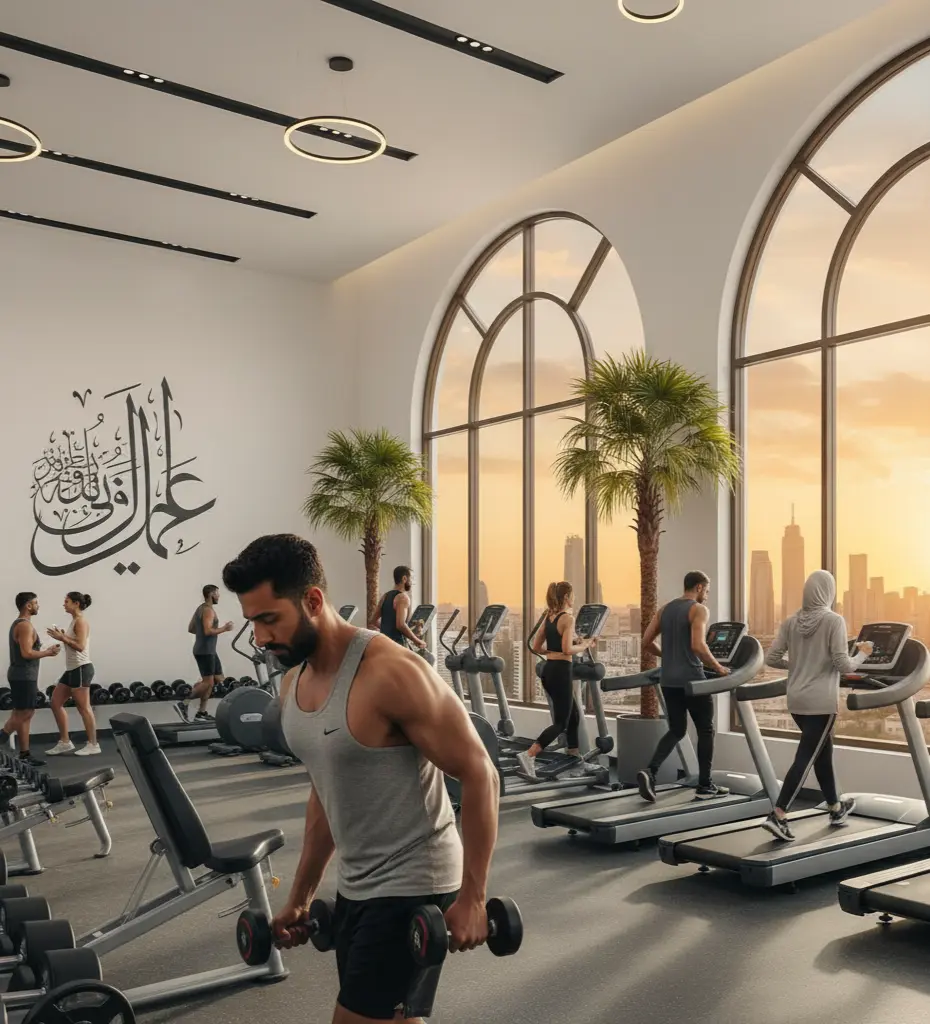
Executive Summary
The UAE fitness market is undergoing a structural transformation, with its total market size estimated at approximately US$1.8-2.0 billion in 2026, projected to reach US$3.2-3.6 billion by 2032, reflecting a CAGR of 9.5-11.5 percent. This growth is being driven by a combination of government-led wellness initiatives, rising lifestyle diseases (with obesity prevalence exceeding 27-30 percent among adults), and increasing participation among women and expatriate populations.
Recent developments such as the expansion of national fitness initiatives in Dubai and Abu Dhabi, alongside corporate wellness adoption, have significantly improved gym penetration rates, now estimated at 12-15 percent of the population, compared to under 8 percent a decade ago. The rise of boutique studios and hybrid fitness models has also reshaped monetization, with per-user revenue in premium segments exceeding US$1,500 annually.
Structurally, the market is bifurcating between premium experiential fitness and high-volume budget gyms, driven by income disparities across expatriate cohorts. Simultaneously, real estate developers are integrating fitness into residential ecosystems, fundamentally altering demand channels.
For investors and operators, the UAE represents a high-yield, premium-driven fitness market with strong unit economics but rising competitive intensity and cost pressures.
Market Overview
The UAE fitness market has evolved from a niche, expatriate-driven activity in the early 2000s into a policy-supported, lifestyle-integrated sector. Historically concentrated in luxury hotel gyms and premium clubs, the market has expanded into mid-tier and budget formats due to demographic diversification and rising health awareness.
Macroeconomic drivers are central to this evolution. The UAE's GDP per capita exceeds US$45,000, enabling discretionary spending on fitness, while a working-age population of over 70 percent supports sustained demand. However, the trigger for accelerated fitness adoption has been public health concerns, particularly obesity and diabetes, with diabetes prevalence exceeding 16-18 percent among adults. This has led to nationwide campaigns and infrastructure investments promoting physical activity.
Government-led initiatives such as Dubai Fitness Challenge have catalyzed behavioral change, with participation exceeding 2.3 million individuals annually, creating a recurring demand funnel for gyms and studios. Additionally, urban planning policies increasingly mandate fitness facilities in residential developments, embedding fitness into daily life.
From a supply perspective, the market remains fragmented but rapidly formalizing. Organized chains are expanding aggressively, particularly in Dubai, which accounts for 50-60 percent of total market revenue, due to its high expatriate density and tourism-driven demand.
Environmental factors such as extreme climate conditions (temperatures exceeding 40°C for over 4-5 months annually) also structurally favor indoor fitness facilities, increasing dependency on gyms rather than outdoor activity.
The convergence of policy, climate, and demographic factors has created a structurally resilient, consumption-driven fitness market, with strong long-term growth visibility.
Market Size & Growth Outlook
UAE Fitness Market Size
Values shown in US$ billion
UAE Fitness Market Size and YoY Growth
| Year | Market Size (US$ B) | YoY Growth (%) |
|---|---|---|
| 2020 | 1.10 | 3.5% |
| 2021 | 1.25 | 13.6% |
| 2022 | 1.40 | 12.0% |
| 2023 | 1.55 | 10.7% |
| 2024 | 1.70 | 9.7% |
| 2025 | 1.85 | 8.8% |
| 2026 | 2.00 | 8.1% |
| 2027 | 2.20 | 10.0% |
| 2028 | 2.45 | 11.4% |
| 2029 | 2.75 | 12.2% |
| 2030 | 3.05 | 10.9% |
| 2031 | 3.35 | 9.8% |
| 2032 | 3.60 | 7.5% |
Between 2020 and 2026, the UAE fitness market grew at a CAGR of approximately 10.4 percent, with growth initially triggered by post-COVID health awareness and pent-up demand. The reopening phase saw membership growth rates exceeding 15-18 percent in 2021-2022, particularly in mid-tier and budget gyms.
From 2026 onward, growth is expected to stabilize at 9.5-11.5 percent CAGR, driven by structural factors rather than cyclical recovery. Key drivers include increasing female participation (projected to rise from ~25 percent to over 35 percent of memberships by 2030) and expansion of corporate wellness programs covering 20-25 percent of the employed population.
Capital inflows are also accelerating, with estimated investments of US$500-700 million expected over the next five years, particularly in boutique studios and franchised gym models. Additionally, hybrid fitness models are increasing revenue per user by 10-15 percent, offsetting membership saturation risks.
The moderation in growth post-2030 reflects market maturation in premium segments, but expansion into mid-income demographics and Northern Emirates will sustain overall momentum.
Market Segmentation
By Membership / Pricing Model
By Membership / Pricing Model
- Budget Gyms35%
- Mid-Tier Gyms30%
- Premium / Luxury Clubs25%
- Pay-Per-Class / Subscription10%
By Membership / Pricing Model
| Segment | Description | Share (%) |
|---|---|---|
| Budget Gyms | High-volume, low-cost fitness chains targeting expatriates | 35% |
| Mid-Tier Gyms | Balanced pricing with diversified offerings | 30% |
| Premium / Luxury Clubs | High-end experiential fitness with integrated wellness | 25% |
| Pay-Per-Class / Subscription | Flexible boutique and digital models | 10% |
The segmentation reflects a dual-speed market structure, where budget gyms dominate volume (35 percent share) due to price sensitivity among expatriates, while premium clubs capture disproportionate revenue due to higher ARPU.
Budget gyms have expanded rapidly, particularly in Sharjah and Northern Emirates, where monthly memberships average US$40-60, enabling penetration into blue-collar and mid-income segments. The growth is triggered by cost-of-living pressures and rising expatriate population, forcing operators to adopt high-density, low-cost models.
Premium clubs, concentrated in Dubai, generate ARPU exceeding US$1,200-1,800 annually, supported by value-added services such as recovery, nutrition, and concierge fitness. However, growth is moderating due to market saturation.
Mid-tier gyms are emerging as a strategic bridge segment, benefiting from consumers trading down from premium and upgrading from budget.
Pay-per-class models, though smaller, are growing at 15-18 percent annually, driven by flexibility and lifestyle-oriented consumption patterns.
By End User
By End User
By End User
| Segment | Description | Share (%) |
|---|---|---|
| Individual Consumers | Core fitness participants | 50% |
| Women-Only Segment | Gender-specific gyms and studios | 20% |
| Corporate Employees | Employer-sponsored fitness | 15% |
| Youth & Students | School/university engagement | 10% |
| HNWIs | Ultra-premium personalized fitness | 5% |
Individual consumers dominate due to high urbanization and lifestyle-driven fitness adoption. However, the most structurally important shift is the rise of female participation, driven by cultural adaptation and increasing availability of women-only facilities.
Women-only gyms account for 20 percent of total memberships, with higher retention rates (~70-75 percent vs ~55-60 percent industry average), making them a high-value segment.
Corporate wellness is expanding rapidly, particularly in Abu Dhabi, where government-linked entities are integrating fitness into employee benefits. This segment is expected to grow to 20 percent share by 2030, driven by productivity-linked incentives.
HNWIs, while small in volume, generate 2-3x higher revenue per user, making them strategically important for premium operators.
By Facility Type
By Facility Type
- Standalone Gyms50%
- Residential Gyms20%
- Hotel-Based Gyms15%
- Outdoor/Public Fitness15%
By Facility Type
| Segment | Description | Share (%) |
|---|---|---|
| Standalone Gyms | Core revenue-generating fitness centers with scalable membership models | 50% |
| Residential Gyms | Developer-integrated facilities within housing communities | 20% |
| Hotel-Based Gyms | Premium facilities targeting tourists and business travelers | 15% |
| Outdoor/Public Fitness | Government-funded fitness infrastructure | 15% |
The UAE fitness infrastructure landscape is undergoing a structural shift from centralized gym models to distributed, convenience-led access points, fundamentally altering demand patterns and competitive positioning.
Standalone gyms continue to dominate due to higher revenue density per square foot, with average annual revenue per facility ranging between US$1.5-3.0 million depending on tier. However, their dominance is increasingly challenged by embedded fitness ecosystems, particularly residential gyms, which are reshaping consumer behavior by reducing friction (travel time, cost barriers).
Residential gyms are growing at 12-14 percent annually, driven by real estate developers such as Emaar and DAMAC integrating fitness as a core amenity. This shift is not incidental but economically motivated-properties with integrated fitness infrastructure command 5-12 percent higher rental and sale premiums, effectively subsidizing fitness access through real estate pricing. For operators, this creates both a threat (reduced gym dependency) and an opportunity (B2B partnerships with developers).
Hotel-based gyms, while historically premium, are facing utilization inefficiencies, with occupancy-linked demand leading to 30-40 percent capacity underutilization during off-peak tourism periods. This has triggered a strategic pivot where hotels are opening memberships to external users, effectively competing with standalone premium gyms.
Outdoor and public fitness infrastructure is expanding rapidly, with the UAE government investing heavily in cycling tracks (over 500 km nationally) and public fitness zones. While these do not directly generate revenue, they play a market-creation role, increasing baseline fitness participation and acting as a top-of-funnel acquisition channel for commercial gyms.
By Fitness Modality
By Fitness Modality
By Fitness Modality
| Segment | Description | Share (%) |
|---|---|---|
| Strength & Conditioning | Weight training, bodybuilding, functional fitness | 30% |
| Cardio & Endurance | Running, cycling, aerobic training | 25% |
| Sports-Based Fitness | Boxing, MMA, swimming, sports academies | 20% |
| Mind-Body Fitness | Yoga, Pilates, meditation | 15% |
| Recovery & Wellness | Physiotherapy, cryotherapy, mobility training | 10% |
The UAE fitness modality mix reflects a transition from aesthetic-driven fitness to performance and wellness-oriented consumption, driven by both demographic and psychological factors.
Strength and conditioning remains dominant due to its alignment with visible physical outcomes, particularly among younger male demographics. However, growth in this segment is stabilizing (~6-8 percent CAGR), indicating maturity and saturation in traditional gym offerings.
In contrast, mind-body fitness is expanding at 14-16 percent CAGR, driven by rising stress levels, corporate burnout, and increasing female participation. The UAE's high-pressure work culture, particularly in Dubai, has created demand for mental wellness-integrated fitness, making yoga and Pilates not just fitness activities but lifestyle necessities. Studios in this segment report higher retention rates (~70-75 percent) compared to traditional gyms.
Sports-based fitness is benefiting from government investments in sports infrastructure and youth engagement programs, with participation rates increasing by 10-12 percent annually. Combat sports and boxing, in particular, are gaining traction due to their high-intensity, skill-based appeal.
The most strategically significant shift is the rise of recovery and wellness services, which, despite a smaller share, are growing at 18-20 percent CAGR. This growth is triggered by increased awareness of injury prevention and longevity, particularly among high-income users. Premium gyms now derive 15-20 percent of total revenue from recovery services, fundamentally changing unit economics.
By Geography
By Geography
- Dubai55%
- Abu Dhabi30%
- Sharjah & Northern Emirates15%
By Geography
| Segment | Description | Share (%) |
|---|---|---|
| Dubai | Primary fitness hub with premium concentration | 55% |
| Abu Dhabi | Policy-driven, high-income market | 30% |
| Sharjah & Northern Emirates | Emerging, price-sensitive markets | 15% |
Geographic distribution in the UAE fitness market is highly skewed, with Dubai functioning as both the innovation hub and revenue anchor, contributing over half of total market value. This dominance is driven by its expatriate population (over 85 percent of residents) and tourism inflows exceeding 15 million annually, both of which create consistent demand for fitness services.
Dubai's market is characterized by premiumization and format innovation, with the highest density of boutique studios and luxury fitness clubs. However, this also results in market saturation, with gym density exceeding 1 facility per 10,000-12,000 residents, leading to increasing competition and customer acquisition costs.
Abu Dhabi presents a structurally different market, where growth is policy-led rather than consumer-driven. Government initiatives targeting public health and employee wellness are driving adoption, with higher per capita fitness spending but lower facility density compared to Dubai. This creates a high-margin, underpenetrated opportunity for operators.
Sharjah and Northern Emirates represent the next growth frontier, with gym penetration under 8 percent, compared to 15-18 percent in Dubai. The market here is driven by price sensitivity and population growth, particularly among mid-income expatriates. Operators entering these markets benefit from 30-40 percent lower real estate costs, enabling stronger unit economics despite lower pricing.
Trends & Developments
Premiumization and Experience-Led Fitness
The UAE fitness market has shifted decisively toward experience-led consumption, where gyms are no longer evaluated purely on equipment or accessibility but on the quality of engagement and lifestyle integration they offer. Prior to this transition, premium gyms differentiated primarily through brand positioning and location; however, increasing competition and evolving consumer expectations-particularly among high-income expatriates in Dubai-have pushed operators to redesign facilities into multi-dimensional wellness environments.
This evolution has materially altered revenue models. Premium operators incorporating recovery zones, curated group experiences, and personalized coaching are generating 25-35 percent higher ARPU, while also extending average customer lifetime by improving retention rates to 70-75 percent. The underlying driver is a shift from price sensitivity to value sensitivity, where users evaluate fitness as part of a broader lifestyle spend rather than a discretionary expense.
At the same time, this transformation has increased capital intensity. Fit-out costs for premium facilities have risen to US$150-250 per square foot, and ongoing operational expenses-including specialized staff and energy consumption-have increased proportionally. As more operators pursue similar experience-driven models, differentiation risks narrowing, potentially eroding pricing power over time.
This creates a structural tension: while premiumization enhances revenue per user, it simultaneously raises the break-even threshold, making location selection, brand equity, and customer segmentation increasingly critical to profitability.
Rise of Boutique and Specialized Studios
Boutique fitness studios have transitioned from niche offerings to core competitive threats, particularly in high-density urban clusters. Their growth reflects a broader consumer shift toward specialization, efficiency, and community-driven engagement, rather than generalized fitness access.
Consumers are increasingly favoring high-intensity, time-efficient formats, with willingness to pay US$25-40 per session for structured classes that deliver measurable outcomes. This has resulted in 2-3x higher revenue per square foot compared to traditional gyms, making boutique formats significantly more capital-efficient despite smaller footprints.
The rise of boutique studios has also reshaped user behavior. Instead of long-term memberships with inconsistent usage, consumers are adopting modular fitness routines, combining multiple specialized formats (e.g., HIIT, Pilates, boxing) across the week. This increases engagement frequency but reduces reliance on a single provider, fragmenting customer loyalty.
However, the rapid expansion of boutique studios-especially in Dubai-is leading to micro-market saturation, where multiple studios compete within limited catchment areas. This intensifies competition for high-value users and raises customer acquisition costs, particularly as digital marketing channels become more crowded.
As a result, sustainability in this segment increasingly depends on brand differentiation, instructor quality, and community-building, rather than format alone, as the novelty of specific workout types diminishes over time.
Integration of Digital and Hybrid Fitness Models
Digital fitness has evolved into a core engagement infrastructure, rather than a standalone offering. While initial adoption was triggered by COVID-19 restrictions, its continued relevance is driven by its ability to extend the fitness experience beyond physical spaces, addressing one of the industry's most persistent challenges-high churn rates.
Currently, 30-40 percent of users in premium segments engage in hybrid fitness models, combining in-gym workouts with digital tracking, virtual classes, and personalized plans. This integration has led to measurable improvements, including:
10-15 percent increase in revenue per user
20-30 percent reduction in churn
The mechanism behind this impact is continuous engagement. By maintaining user interaction outside the gym environment, operators reinforce habit formation and increase perceived value, reducing the likelihood of membership cancellation.
However, the rapid push toward digitalization has also exposed inefficiencies. Many operators have invested in standalone apps or platforms without clear differentiation, resulting in low user adoption and underutilized features. In such cases, digital investments become cost centers rather than value drivers.
Sustainable success in this space depends on seamless integration with physical offerings, where digital tools enhance, rather than replace, the in-person experience. The focus is shifting toward data-driven personalization, where user behavior is leveraged to tailor workouts, track progress, and optimize engagement.
Expansion of Women-Centric Fitness Ecosystems
Female participation in the UAE fitness market is undergoing a structural expansion, transforming a historically underpenetrated segment into one of the most reliable growth drivers. This shift is supported by rising female workforce participation, evolving cultural norms, and increased availability of women-only fitness facilities.
Women currently account for approximately 20-25 percent of total memberships, with projections indicating growth beyond 35 percent by 2030. Importantly, this segment demonstrates superior engagement metrics, including retention rates of 70-75 percent, compared to the broader industry average of 55-60 percent.
The higher retention is driven by several factors:
Preference for group-based, community-oriented workouts
Greater consistency in fitness routines
Stronger alignment with wellness and lifestyle goals
Operators targeting this segment have also been able to command premium pricing, particularly in boutique and women-only environments, where privacy and tailored programming are valued.
Despite this growth, supply remains uneven across emirates, with a higher concentration of women-centric facilities in urban hubs like Dubai and limited penetration in Sharjah and Northern Emirates. This creates a geographic imbalance in access, presenting expansion opportunities for operators willing to localize offerings.
At the same time, there is a risk of overgeneralization, where operators assume uniform preferences across female users. The segment is becoming increasingly diverse, requiring more nuanced positioning across age groups, income levels, and fitness objectives.
Growth of Recovery, Longevity, and Wellness Services
Recovery and wellness services are emerging as a critical monetization layer, shifting fitness from a performance-focused activity to a broader longevity-oriented ecosystem. This transition is driven by increasing awareness of injury prevention, aging, and holistic health, particularly among high-income and older demographics.
Services such as cryotherapy, physiotherapy, assisted stretching, and mobility training are growing at 18-20 percent CAGR, significantly outpacing traditional fitness modalities. In premium clubs, these services now contribute 15-20 percent of total revenue, reflecting a fundamental shift in consumer spending patterns.
The rise of recovery services also alters user expectations. Fitness is no longer limited to exertion but includes optimization, restoration, and long-term health management. This creates opportunities for cross-selling and bundling services, increasing overall customer lifetime value.
However, the segment is capital- and expertise-intensive, requiring specialized equipment and trained professionals. Operators entering this space without adequate differentiation or clinical credibility risk commoditization, particularly as more players adopt similar offerings.
As the market evolves, the distinction between fitness providers and wellness providers is blurring, with successful operators positioning themselves as integrated health platforms rather than standalone gyms.
Real Estate-Fitness Integration
Fitness is increasingly being embedded into the UAE's real estate ecosystem, fundamentally changing how demand is generated and captured. Developers are integrating gyms, wellness centers, and outdoor fitness spaces into residential and mixed-use projects, transforming fitness from a discretionary activity into a built-in lifestyle component.
This trend is economically driven. Properties with integrated fitness amenities command 5-12 percent higher premiums, making fitness infrastructure a value-enhancing investment for developers. As a result, residential gyms are growing at 12-14 percent annually, reducing reliance on external gym memberships.
For traditional fitness operators, this creates a disintermediation risk, as a portion of demand is absorbed within residential ecosystems. However, it also opens new avenues for growth through B2B partnerships, where operators manage or co-develop fitness facilities within residential projects.
The long-term impact is a shift toward distributed fitness access, where consumers engage with multiple fitness touchpoints-home, community, and specialized studios-rather than relying on a single gym.
This fragmentation of access points increases competition but also expands the overall market, as convenience lowers barriers to participation and increases overall fitness engagement.
Competitive Landscape
Competitive Landscape — Market Share
Competitive Landscape
| Company | Description | Market Share (%) |
|---|---|---|
| Fitness First Middle East | Premium leader with extensive network and brand equity | 18% |
| GymNation | Budget disruptor with aggressive expansion | 15% |
| Gold's Gym UAE | Established global brand with diversified offerings | 12% |
| Warehouse Gym | Boutique-industrial concept focused on experience | 10% |
| Barry's UAE | Premium HIIT boutique with high ARPU model | 8% |
| Others | Fragmented local and niche players | 37% |
The UAE fitness market is characterized by a barbell competitive structure, where scale-driven budget operators and experience-led premium players dominate, while mid-tier operators face increasing pressure.
Fitness First maintains leadership through its extensive network of 40+ facilities and strong brand equity, but its growth has slowed as boutique competitors capture high-value segments. Its strategy has increasingly focused on facility upgrades and digital integration to defend its premium positioning.
GymNation represents the most disruptive force in the market, leveraging a low-cost, high-volume model to rapidly expand across emirates. With 10+ locations and aggressive pipeline expansion, it has redefined pricing benchmarks, forcing competitors to reconsider their cost structures and value propositions.
Gold's Gym UAE operates a hybrid model, catering to both mid-tier and premium segments, but faces challenges in maintaining differentiation amid increasing competition.
Boutique players such as Warehouse Gym and Barry's are capturing high-margin segments, with ARPU levels significantly exceeding industry averages. Their growth is driven by brand identity, community engagement, and experiential design, rather than scale.
The market is also witnessing increasing consolidation, particularly in the budget segment, where scale is critical to maintaining profitability under pricing pressure. At the same time, boutique players are focusing on network expansion within micro-markets, creating localized dominance.
A key structural dynamic is the competition between standalone operators and integrated ecosystems (real estate, corporate wellness, and digital platforms). Operators that successfully integrate across these channels are better positioned to capture and retain users.
Challenges & Opportunities
Key Challenges
High Operating Costs and Real Estate Pressure
Operating a fitness facility in prime UAE locations involves significant cost burdens, with real estate expenses alone accounting for 25-35 percent of total operating costs. In areas such as Dubai Marina and Downtown, rental rates can exceed US$80-120 per square foot annually, creating high fixed cost structures.
These costs are further exacerbated by high energy consumption due to climate conditions and staffing costs for specialized trainers and wellness professionals. As competition intensifies, passing these costs onto consumers becomes increasingly difficult, particularly in the mid-tier segment. This creates margin compression and forces operators to either scale rapidly or reposition their offerings. The long-term risk lies in overcapacity in premium locations, where multiple operators compete for the same customer base, reducing utilization rates and profitability.
Customer Retention and High Churn Rates
The UAE fitness market continues to face structurally high churn rates, with annual attrition levels of 40-50 percent. This is driven by seasonal usage patterns (drop-offs during summer and travel periods), price sensitivity among expatriate populations, and lack of long-term engagement mechanisms.
High churn significantly increases customer acquisition costs, with operators spending 20-30 percent of revenue on marketing and promotions in some cases. Without strong retention strategies-such as community building, digital engagement, and personalized programs-operators risk becoming transactional service providers rather than long-term engagement platforms.
Market Fragmentation and Pricing Pressure
The presence of numerous small and independent operators creates intense pricing competition, particularly in the budget and mid-tier segments. This leads to discount-driven customer acquisition, reduced pricing power, and margin erosion across the industry. As more players enter the market, differentiation becomes increasingly difficult, particularly for mid-tier gyms that lack both scale and premium positioning.
Key Opportunities
Expansion into Mid-Income and Northern Emirates
Sharjah and Northern Emirates represent a high-growth, underpenetrated segment, with gym penetration under 8 percent, compared to 15-18 percent in Dubai. Population growth and rising income levels are driving demand, while lower real estate costs improve unit economics.
Operators entering these markets can achieve 30-40 percent lower operating costs, faster break-even periods, and higher volume-driven growth. This creates a strong case for budget and mid-tier expansion strategies, particularly for scalable chains.
Corporate Wellness Integration
Corporate wellness is emerging as a stable, recurring revenue stream, with programs expected to cover 25-30 percent of employees by 2030. Employers are increasingly linking fitness to productivity, absenteeism reduction, and healthcare cost management.
This segment offers lower customer acquisition costs, higher retention rates, and predictable revenue streams. Operators that build dedicated corporate solutions-rather than generic memberships-are better positioned to capture this opportunity.
Hybrid and Digital Monetization
Digital integration enables operators to increase revenue per user without proportional increases in physical capacity, improving scalability. Hybrid models also reduce churn by maintaining engagement outside the gym environment.
As data capabilities improve, operators can leverage user insights to personalize offerings, optimize pricing strategies, and enhance customer lifetime value. This positions digital not just as a support function, but as a core driver of long-term profitability and differentiation.
Key Policies & Regulatory Environment
The UAE fitness market is significantly shaped by policy-led demand creation and infrastructure investment, with the government actively positioning physical activity as a public health and economic priority. Unlike purely consumer-driven markets, policy interventions in the UAE directly influence participation rates, infrastructure availability, and operator economics.
Dubai Fitness Challenge (DFC)
Launched in 2017, the Dubai Fitness Challenge has emerged as one of the most influential behavioral change programs globally, targeting mass participation in physical activity. The initiative encourages residents to complete 30 minutes of exercise daily for 30 days, and has scaled to over 2.3 million participants annually, representing nearly 25-30 percent of Dubai's population.
Government and associated ecosystem spending on DFC-including events, partnerships, and infrastructure activation-is estimated at US$50-75 million annually. The initiative activates over 1,000 fitness events and locations, and collaborates with 500+ private fitness operators, creating a direct interface between consumers and commercial fitness providers.
The most significant impact of DFC lies in its ability to convert inactive populations into first-time users, effectively expanding the total addressable market. Gym operators report 10-20 percent spikes in trial memberships during and immediately after the challenge period, indicating strong short-term conversion.
However, sustained retention beyond the campaign period remains inconsistent, with many users reverting to inactive lifestyles. This creates a structural dependency where operators must build post-event engagement funnels to capture long-term value from government-driven participation spikes.
National Strategy for Wellbeing 2031
The UAE's National Strategy for Wellbeing 2031 represents a comprehensive policy framework aimed at enhancing quality of life, with physical fitness as a core pillar. The government has committed an estimated US$1.0-1.5 billion toward wellbeing-related initiatives, including wellness programs, digital health platforms, and urban lifestyle integration.
The strategy sets measurable targets, including increasing physical activity participation to 40 percent of the population, reducing obesity rates (currently 27-30 percent), and improving overall life expectancy and health-adjusted life years.
A key differentiator of this policy is its cross-sector integration, embedding fitness into workplace wellness programs across government and semi-government entities, school curricula impacting hundreds of thousands of students annually, and urban planning guidelines that prioritize walkability and active living.
This has led to a structural shift where fitness is no longer discretionary but increasingly institutionalized across daily life environments.
Despite strong funding and intent, the primary challenge lies in measuring behavioral continuity, as participation metrics often capture short-term engagement rather than long-term adherence. This creates a gap between policy ambition and sustained market conversion, particularly in lower-income segments.
UAE National Sports Strategy 2031
The National Sports Strategy 2031 focuses on expanding sports participation and infrastructure, with a total investment estimated at US$600-800 million. While traditionally centered on competitive sports, the strategy has increasingly emphasized grassroots participation and community-level engagement, directly benefiting the fitness ecosystem.
Key initiatives include development and modernization of 100+ community sports facilities, expansion of youth engagement programs covering 500,000+ students annually, and integration of sports into public education and community programs.
The strategy has contributed to a 10-12 percent annual increase in participation in sports-based fitness activities, including boxing, MMA, and football training. These activities often act as entry points into structured fitness, increasing long-term gym membership conversion.
The policy also supports the growth of sports-specific training facilities and academies, creating new sub-segments within the fitness market.
However, there is a potential imbalance in capital allocation, where investments in elite sports infrastructure may not always translate into accessible, mass-market fitness participation, particularly in smaller emirates.
UAE Public Health Programs (Obesity & Diabetes Reduction)
The UAE government has prioritized tackling lifestyle diseases, with obesity affecting 27-30 percent of adults and diabetes prevalence exceeding 16-18 percent. Public health spending on prevention, awareness, and screening programs is estimated at US$300-500 million annually.
Key interventions include nationwide screening programs reaching millions of residents annually, mandatory calorie labeling across food outlets, insurance-linked wellness incentives encouraging physical activity, and workplace health mandates in public sector organizations.
These programs are shifting the healthcare model from treatment to prevention, directly increasing demand for fitness services as a preventive tool. Insurance providers are also beginning to incentivize gym memberships and wellness participation, creating financial drivers for fitness adoption.
The impact is visible in rising awareness and participation, particularly among middle- and high-income populations. However, lower-income segments-especially in Northern Emirates-continue to show lower engagement levels, indicating uneven policy effectiveness across demographics.
This creates a dual-speed market where policy-driven demand is strongest in urban centers like Dubai and Abu Dhabi, while peripheral regions lag in adoption despite similar health risks.
Future Outlook
The UAE fitness market is expected to reach approximately US$3.6 billion by 2032, driven by a combination of policy support, demographic shifts, and evolving consumer behavior.
The market will increasingly evolve into a multi-layered ecosystem, where physical gyms, digital platforms, and wellness services operate in an integrated manner. Growth will be led by expansion into underserved geographic segments, increased female participation, and rising demand for wellness and longevity services.
At the same time, competition will intensify, particularly in saturated urban markets, requiring operators to focus on differentiation, retention, and operational efficiency.
Over the next decade, the defining characteristic of successful players will be their ability to transition from fitness providers to holistic health and wellness platforms, capturing a larger share of consumer health spending.
Contact
Email: sales@aloraadvisory.com
Phone: +353 87 457 1343 | +91 704 542 4192
Frequently Asked Questions
What is the current size of the UAE fitness market?
Approximately US$2.0 billion in 2026.
What is the expected growth rate?
CAGR of 9.5-11.5 percent between 2026 and 2032.
Which segment dominates the market?
Budget gyms dominate in volume, while premium gyms lead in revenue.
What are the key growth drivers?
Government initiatives, rising lifestyle diseases, increasing female participation, and digital integration.
What are the major challenges?
High operating costs, customer churn, and pricing pressure.
About Us
Alora Advisory is a market research and strategic advisory firm that helps organizations make confident, evidence led decisions in uncertain environments. It combines rigorous research with strategic interpretation to deliver decision ready market intelligence across growth, competition, and investment priorities.