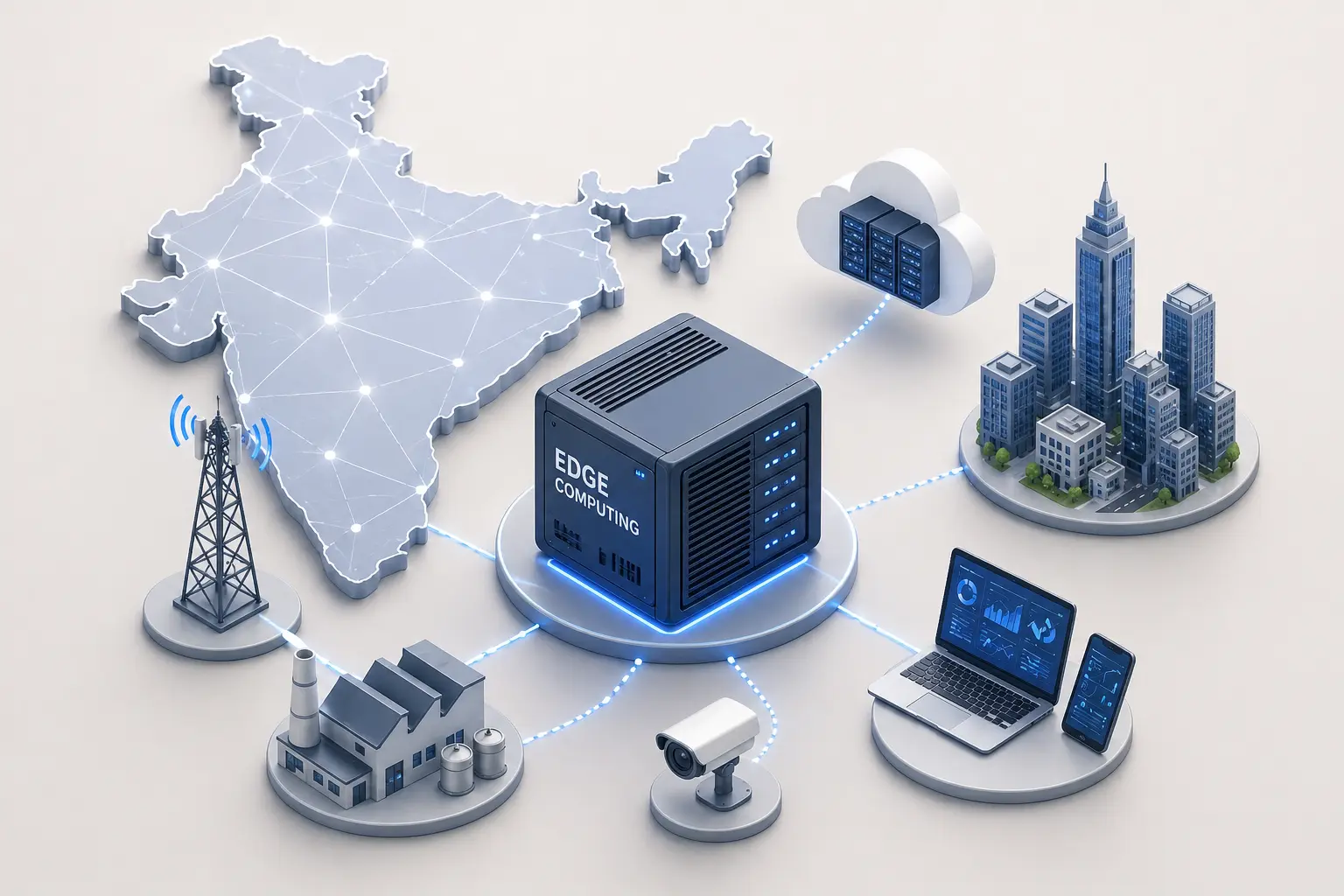
Executive Summary
India’s edge computing market is entering a high-growth phase, with an estimated size of US$2.5–3.0 billion in 2026, projected to reach US$8.0–10.0 billion by 2030, expanding at a CAGR of 28–32 percent. This growth is structurally driven by the convergence of 5G rollout, exponential data generation (expected to exceed 5 zettabytes annually by 2030), and enterprise digital transformation.
Recent developments, including accelerated 5G deployment by operators such as Reliance Jio and Bharti Airtel, alongside hyperscaler expansion by Amazon Web Services and Microsoft Azure, are reshaping the infrastructure landscape. Edge computing is transitioning from a niche architecture to a critical enabler of low-latency applications, including AI inference, industrial IoT, and real-time analytics.
The market’s structural drivers include data localization mandates, rising enterprise cloud adoption, and latency-sensitive use cases. For stakeholders, the shift toward distributed computing architectures is redefining value pools, with growth increasingly concentrated in software orchestration, edge services, and telecom-integrated infrastructure rather than hardware alone.
Market Overview
India’s edge computing market has evolved from early-stage content delivery optimization to a multi-layered distributed computing ecosystem. Initially driven by CDN providers to reduce latency for video streaming, the market is now expanding into enterprise and industrial applications, including manufacturing automation and smart infrastructure.
A key driver is India’s rapid digitalization. With over 900 million internet users and mobile data consumption exceeding 20–25 GB per user per month, the need for low-latency processing has intensified. This is further amplified by 5G, which enables ultra-low latency (under 10 ms) and supports edge-native applications.
Policy frameworks such as data localization under India’s digital regulations are also shaping the market. Enterprises are increasingly required to process and store data locally, driving demand for distributed edge infrastructure.
Macroeconomically, India’s digital economy is expected to reach US$1.0 trillion by 2030, creating a strong demand base for edge computing. Additionally, the rise of AI workloads, which require real-time inference rather than centralized processing, is accelerating adoption.
However, the market remains fragmented, with infrastructure concentrated in metro cities such as Mumbai and Bengaluru, while Tier 2 and Tier 3 regions are still in early stages of deployment. This creates both a constraint and a significant growth opportunity.
Market Size & Growth Outlook
Market Size & Growth Outlook
Values shown in US$ billion
Market Size & Growth Outlook
| Year | Market Size (US$ Billion) | YoY Growth (%) |
|---|---|---|
| 2020 | 0.8 | 18.0% |
| 2021 | 1.1 | 37.5% |
| 2022 | 1.5 | 36.4% |
| 2023 | 1.9 | 26.7% |
| 2024 | 2.3 | 21.1% |
| 2025 | 2.7 | 17.4% |
| 2026 | 3.0 | 11.1% |
| 2027 | 4.0 | 33.3% |
| 2028 | 5.3 | 32.5% |
| 2029 | 6.8 | 28.3% |
| 2030 | 8.8 | 29.4% |
Between 2020 and 2026, India’s edge computing market expanded at a CAGR of approximately 24 percent, but this growth was uneven and driven by distinct structural triggers. The sharp acceleration in 2021–2022 (36–37 percent YoY growth) was primarily a result of pandemic-induced digital adoption, which increased cloud workloads, video consumption, and enterprise digitization. This created an initial demand surge for localized computing infrastructure, particularly in content delivery and telecom networks. However, growth moderated to ~11–21 percent during 2023–2026, reflecting a transition from experimental deployments to more measured, ROI-driven investments by enterprises.
A critical inflection point begins post-2026, where growth accelerates to ~30 percent CAGR through 2030, driven by the commercialization of 5G and the scaling of enterprise use cases. Unlike the first phase, which was infrastructure-led, the next phase is use-case driven, with AI inference, industrial IoT, and real-time analytics becoming primary demand catalysts. This shift fundamentally changes revenue composition, with software and services expected to grow faster than hardware, increasing overall market value.
Another structural driver is the exponential rise in data generation. India’s data consumption is expected to exceed 5 zettabytes annually by 2030, necessitating distributed processing to avoid latency and bandwidth constraints associated with centralized cloud models. This creates sustained demand for edge nodes across telecom, enterprise, and cloud ecosystems.
Investment flows further reinforce this trajectory. Hyperscalers and telecom operators, including Reliance Jio, are collectively investing US$5.0–7.0 billion in edge infrastructure, including micro data centers and 5G-integrated edge nodes. These investments are not incremental but foundational, enabling scalable deployment of latency-sensitive applications.
Importantly, market growth will increasingly be value-accretive rather than volume-driven. While the number of edge nodes will grow steadily, the monetization per node will increase due to higher-value workloads such as AI processing and real-time analytics. This results in a divergence between infrastructure expansion and revenue growth, with higher-margin software and services driving overall market expansion.
For stakeholders, the implication is a transition toward a distributed computing economy, where competitive advantage will depend on ecosystem integration (cloud, telecom, and enterprise) rather than standalone infrastructure deployment.
Market Segmentation
By Component
By Component
- Hardware50%
- Software30%
- Services20%
By Component
| Segment | Description | Market Share (%) |
|---|---|---|
| Hardware | Edge servers, gateways, micro data centers | 50% |
| Software | Edge orchestration, analytics, security | 30% |
| Services | Managed and integration services | 20% |
The India edge computing market is currently hardware-dominated (~50 percent share), reflecting its early-stage infrastructure build-out phase. Investments are concentrated in edge servers, micro data centers, and networking equipment, driven by telecom operators and data center providers scaling capacity for 5G and distributed workloads. This hardware-heavy phase is typical of emerging edge markets, where foundational infrastructure precedes application-layer monetization. However, this dominance is transitional rather than structural.
Software (~30 percent share) represents the fastest-growing component, expected to expand at 30–35 percent CAGR through 2030. This growth is driven by increasing complexity in managing distributed environments, requiring orchestration platforms, edge-native analytics, and cybersecurity solutions. As enterprises deploy multiple edge nodes across locations, centralized control layers become critical, shifting value toward software providers. AI-driven workloads further accelerate this trend, as real-time inference requires advanced analytics capabilities at the edge.
Services (~20 percent share) are emerging as a key enabler of adoption, particularly for enterprises lacking in-house expertise. Managed services and system integration are expected to grow rapidly as organizations transition from pilot deployments to scaled implementations. Notably, service-led models are gaining traction in Tier 2 and Tier 3 cities, where enterprises prefer outsourced infrastructure management.
The structural shift in this segmentation is from capex-heavy hardware spending to opex-driven software and services models. Over time, hardware share is expected to decline to ~35–40 percent, while software and services together exceed 60 percent.
By Deployment Type
By Deployment Type
- Telecom Edge40%
- Cloud Edge35%
- On-Premise Edge25%
By Deployment Type
| Segment | Description | Market Share (%) |
|---|---|---|
| Telecom Edge | Edge within telecom networks | 40% |
| Cloud Edge | Hyperscaler-driven edge | 35% |
| On-Premise Edge | Enterprise-owned edge | 25% |
Telecom edge currently leads the market with ~40 percent share, driven by aggressive 5G rollout by operators such as Reliance Jio and Bharti Airtel. Telecom operators are deploying edge nodes within their network infrastructure to enable ultra-low latency applications (under 10 ms), making this segment foundational for the broader edge ecosystem. The rapid expansion of 5G base stations is directly correlated with edge node deployment, creating a tightly coupled growth trajectory.
Cloud edge (~35 percent share) is expanding through hyperscaler investments, with players such as Amazon Web Services and Microsoft Azure extending their infrastructure closer to end users. This model enables enterprises to leverage edge capabilities without owning infrastructure, accelerating adoption among digital-native businesses. Hyperscalers are increasingly partnering with telecom operators to integrate cloud and network edge, creating hybrid deployment models.
On-premise edge (~25 percent share) remains relevant for industries with strict latency, security, or compliance requirements, such as manufacturing and BFSI. However, its growth is constrained by high upfront costs and operational complexity. Enterprises are gradually shifting toward hybrid models that combine on-premise control with cloud scalability.
The structural evolution of this segmentation is toward converged architectures, where telecom and cloud edge increasingly overlap. By 2030, the distinction between these categories is expected to blur, with integrated edge platforms dominating the market.
By End-User Industry
By End-User Industry
By End-User Industry
| Segment | Description | Market Share (%) |
|---|---|---|
| Telecom & IT | Infrastructure and cloud providers | 35% |
| Manufacturing | Industrial IoT | 20% |
| Retail & E-commerce | Real-time analytics | 15% |
| Government & Smart Cities | Urban infrastructure | 12% |
| BFSI | Financial services | 10% |
| Healthcare | Remote monitoring | 8% |
The Telecom & IT sector dominates the India edge computing market with ~35 percent share, reflecting its role as both infrastructure provider and early adopter. Telecom operators and cloud providers are deploying edge infrastructure to support 5G, content delivery, and enterprise services. This segment’s growth is closely tied to network expansion and hyperscaler investments, making it the backbone of the market.
Manufacturing (~20 percent share) is the fastest-growing segment, driven by Industry 4.0 adoption. Use cases such as predictive maintenance, real-time quality monitoring, and robotics require ultra-low latency processing, making edge computing essential. India’s push toward manufacturing digitization, supported by government initiatives, is accelerating adoption in this sector.
Retail & e-commerce (~15 percent share) are leveraging edge computing for real-time analytics, including inventory optimization and personalized customer experiences. The rapid growth of e-commerce platforms is increasing demand for localized processing to improve response times and reduce bandwidth costs.
Government & smart cities (~12 percent share) represent a policy-driven segment, with applications in surveillance, traffic management, and public infrastructure. Large-scale projects under national programs are creating steady demand for edge infrastructure.
BFSI (~10 percent) and healthcare (~8 percent) are emerging segments, with adoption driven by real-time fraud detection and remote diagnostics, respectively. However, regulatory and security concerns slow adoption relative to other sectors.
The segmentation is evolving toward enterprise-led demand, with non-telecom sectors expected to account for over 60 percent of incremental growth by 2030.
By Region
By Region
- West India35%
- South India30%
- North India20%
- East India15%
By Region
| Segment | Description | Market Share (%) |
|---|---|---|
| West India | Data center hub (Mumbai) | 35% |
| South India | Tech hub (Bengaluru) | 30% |
| North India | NCR region | 20% |
| East India | Emerging market | 15% |
West India, led by Mumbai, accounts for ~35 percent of the market, driven by its status as India’s largest data center hub. The region benefits from strong connectivity, financial sector demand, and proximity to international subsea cables, making it the primary location for edge infrastructure deployment. High enterprise density further supports demand.
South India (~30 percent share), anchored by Bengaluru, Hyderabad, and Chennai, is driven by the presence of IT and technology companies. This region has a strong ecosystem for cloud and software development, accelerating adoption of edge computing for AI and digital services. Additionally, favorable state policies and infrastructure availability support rapid growth.
North India (~20 percent share), including Delhi NCR, is characterized by strong government and telecom demand. The region benefits from policy-driven projects such as smart cities and public infrastructure initiatives, which require edge-enabled solutions.
East India (~15 percent share) remains underpenetrated but represents the highest growth opportunity, with projected CAGR of 30–35 percent, compared to the national average of ~30 percent. Infrastructure investments and increasing digital adoption are key growth triggers, although challenges such as limited connectivity and data center capacity persist.
The regional distribution reflects a metro-centric concentration, but future growth will increasingly shift toward Tier 2 and Tier 3 cities as latency requirements drive decentralized deployments.
By Latency / Edge Type
By Latency / Edge Type
- Regional Edge45%
- Near Edge35%
- Far Edge20%
By Latency / Edge Type
| Segment | Description | Market Share (%) |
|---|---|---|
| Regional Edge | Micro data centers | 45% |
| Near Edge | Local servers | 35% |
| Far Edge | IoT endpoints | 20% |
Regional edge, accounting for ~45 percent share, represents the dominant layer in India’s edge computing architecture. These are typically micro data centers located in proximity to urban clusters, aggregating data from multiple sources. Their dominance is driven by the need to balance latency reduction with cost efficiency, as fully distributed architectures remain economically unviable at scale.
Near edge (~35 percent share) includes local servers and gateways deployed within enterprise or telecom networks. This segment is critical for applications requiring near-real-time processing, such as industrial automation and telecom network optimization. Growth in this segment is closely linked to enterprise adoption and 5G deployment.
Far edge (~20 percent share) consists of IoT devices and endpoints where data is generated. While currently smaller in revenue contribution, this segment is expected to grow at the fastest rate (~35–40 percent CAGR) due to the proliferation of connected devices, which is projected to exceed 25–30 billion IoT devices globally by 2030, with significant contribution from India.
The architecture is evolving toward a multi-layered edge ecosystem, where processing is distributed across far, near, and regional layers depending on latency requirements and cost considerations. Over time, advancements in hardware and connectivity will enable greater processing at the far edge, reducing reliance on centralized nodes.
Trends & Developments
5G-Driven Edge Expansion:
The rollout of 5G is the single most important catalyst for India’s edge computing market. As of 2025, operators such as Reliance Jio and Bharti Airtel have deployed 350,000–400,000+ 5G base stations, covering over 80–85 percent of urban population. This rollout is directly linked to edge node deployment, as telecom networks increasingly require distributed computing layers to achieve sub-10 millisecond latency.
Telecom operators are investing heavily in edge infrastructure, with cumulative spending on 5G and edge estimated at US$25.0–30.0 billion between 2023 and 2030. Each 5G cluster typically requires localized edge nodes to support applications such as AR/VR, gaming, and industrial automation. As a result, telecom edge deployments are expected to grow at 30–35 percent CAGR, outpacing overall market growth.
Additionally, enterprise private 5G networks are emerging, particularly in manufacturing and logistics, further accelerating localized edge deployment.
Rise of AI and Real-Time Analytics at the Edge
AI workloads are increasingly shifting from centralized cloud environments to edge nodes due to latency and bandwidth constraints. In India, AI-driven applications are expected to account for 35–40 percent of incremental edge computing demand by 2030, compared to less than 10 percent in 2022.
Use cases such as video analytics, predictive maintenance, and real-time fraud detection require latency below 20 milliseconds, which cannot be achieved through centralized cloud processing. This is driving deployment of GPU-enabled edge servers, with AI-capable edge hardware expected to grow at 40 percent+ CAGR.
Data generation is another critical factor. India’s data consumption is projected to exceed 5 zettabytes annually by 2030, with over 60 percent of this data expected to be processed at or near the edge to reduce transmission costs and latency.
Enterprises are also adopting AI inference at the edge to reduce cloud costs, with studies indicating 20–30 percent cost savings compared to centralized processing for high-frequency workloads.
Hyperscaler-Telecom Partnerships:
A defining trend in India’s edge computing market is the convergence of telecom networks and cloud platforms. Partnerships between hyperscalers such as Amazon Web Services, Microsoft Azure, and telecom operators are enabling integrated edge solutions.
These collaborations allow enterprises to deploy applications at telecom edge locations while leveraging cloud-native tools, creating hybrid architectures. For example, hyperscalers are extending availability zones closer to users, reducing latency by 30–50 percent compared to centralized cloud regions.
Investment in such partnerships is substantial, with hyperscalers committing US$3.0–5.0 billion in India’s edge and cloud infrastructure over the next 5–7 years. Telecom operators benefit by monetizing network infrastructure beyond connectivity, while hyperscalers gain access to distributed edge locations.
This model is accelerating enterprise adoption, particularly among digital-native companies, which can deploy edge workloads without owning infrastructure.
Micro Data Centers:
Micro data centers are emerging as the backbone of India’s edge architecture. These modular facilities, typically ranging from 50 kW to 1 MW capacity, are being deployed in urban clusters and Tier 2 cities to support localized processing.
India’s edge data center capacity is expected to grow from ~150–200 MW in 2024 to over 800–1,000 MW by 2030, representing a CAGR of 30–35 percent. This expansion is driven by the need to reduce latency and bandwidth costs associated with centralized data centers.
Deployment is increasingly shifting beyond metro cities such as Mumbai and Bengaluru into Tier 2 markets, where latency-sensitive applications are expanding. Additionally, modular designs reduce deployment time by 30–40 percent compared to traditional data centers, enabling faster scalability.
Energy efficiency is also improving, with modern micro data centers achieving PUE (Power Usage Effectiveness) levels of 1.2–1.4, compared to 1.6+ in older facilities.
Edge-as-a-Service:
The adoption of Edge-as-a-Service (EaaS) is transforming the commercial model of edge computing in India. Instead of investing in infrastructure, enterprises are increasingly opting for subscription-based services, reducing upfront capital expenditure.
EaaS adoption is expected to grow at 35–40 percent CAGR, with service-based models accounting for 25–30 percent of total market revenue by 2030, up from less than 10 percent in 2022. These models typically bundle compute, storage, networking, and software orchestration into a single offering.
This shift is particularly significant for SMEs, which lack the capital and expertise to deploy edge infrastructure independently. By converting capex into opex, EaaS lowers entry barriers and accelerates adoption across sectors such as retail, healthcare, and manufacturing.
Additionally, managed services are becoming a critical component, with enterprises outsourcing 50–60 percent of edge operations to service providers.
Competitive Landscape
Competitive Landscape
Competitive Landscape
| Company | Description | Market Share (%) |
|---|---|---|
| Amazon Web Services | Leading hyperscaler offering edge zones, CDN, and integrated cloud-edge services across India | 22% |
| Microsoft Azure | Strong enterprise-focused edge platform with hybrid cloud and AI integration capabilities | 18% |
| Google Cloud | Expanding edge footprint with AI/ML integration and data analytics capabilities | 10% |
| Reliance Jio | Telecom-led edge infrastructure player leveraging 5G rollout and enterprise services | 15% |
| Bharti Airtel | Telecom and enterprise solutions provider with edge partnerships and data center investments | 12% |
| CtrlS Datacenters | Major domestic data center and edge infrastructure provider expanding into Tier 2 cities | 6% |
| Others | Startups, colocation providers, niche edge platforms | 17% |
The India edge computing market is characterized by a semi-consolidated yet ecosystem-driven competitive structure, where the top players account for approximately 75–80 percent of total market share, but operate across different layers of the value chain. Unlike traditional IT markets, competition is not linear; instead, it is shaped by the convergence of hyperscalers, telecom operators, and data center providers. This creates a multi-layered competitive dynamic, where leadership is determined by the ability to integrate infrastructure, platform capabilities, and enterprise solutions rather than scale in a single segment.
Hyperscalers such as Amazon Web Services and Microsoft Azure dominate the platform layer, collectively holding ~40 percent market share, driven by their early investments and enterprise relationships. AWS, with ~22 percent share, benefits from its first-mover advantage and deep integration of edge services such as Local Zones and Wavelength, supported by a US$12.7 billion investment commitment in India by 2030. Its strength lies in enabling seamless workload migration between cloud and edge, which reduces latency by 30–50 percent for enterprise applications. Microsoft Azure (~18 percent share) differentiates itself through hybrid architectures, leveraging its enterprise ecosystem to drive adoption in regulated sectors such as BFSI and manufacturing. Its ability to integrate on-premise infrastructure with cloud-edge deployments positions it strongly in compliance-heavy environments.
Google Cloud, with a smaller ~10 percent share, is positioning itself as a niche player focused on AI-driven edge computing. Its strategy centers on integrating advanced analytics and machine learning into edge deployments, targeting high-value use cases such as real-time video analytics. However, its relatively smaller enterprise footprint in India limits its scale compared to AWS and Azure, despite significant global investments exceeding US$10 billion in cloud and edge infrastructure.
Telecom operators, particularly Reliance Jio (~15 percent share) and Bharti Airtel (~12 percent share), control the connectivity and last-mile infrastructure layer, which is critical for edge computing. Reliance Jio’s competitive advantage stems from its massive 5G rollout, with over 350,000 base stations deployed, enabling rapid scaling of telecom edge nodes. The company is leveraging this infrastructure to build an integrated platform combining connectivity, cloud, and edge services, positioning itself as a low-cost, high-scale competitor. Bharti Airtel, on the other hand, is focusing on enterprise-led adoption, leveraging partnerships with hyperscalers to deliver edge-enabled solutions, particularly in private 5G networks and enterprise applications. Its strength lies in its established enterprise customer base and service capabilities.
Data center providers such as CtrlS Datacenters (~6 percent share) play a critical role in enabling physical edge infrastructure, particularly through micro data centers and distributed facilities. These players are expanding beyond metro cities into Tier 2 regions, where latency requirements are driving localized deployments. While they benefit from cost advantages and local expertise, their growth is constrained by the significantly larger capital investments made by hyperscalers and telecom operators.
A defining trend across the competitive landscape is the increasing importance of strategic partnerships and platform integration. Hyperscalers are collaborating with telecom operators to deploy edge nodes within network infrastructure, reducing deployment costs and accelerating time-to-market. These alliances can reduce infrastructure costs by 20–30 percent and improve latency performance significantly, creating a competitive advantage over standalone deployments. At the same time, enterprises are entering long-term contracts (3–5 years) with integrated providers, shifting the market toward recurring revenue models rather than one-time infrastructure sales.
Overall, the competitive landscape is transitioning toward an ecosystem-centric model, where value is created through integration across cloud, telecom, and infrastructure layers. Players that can offer end-to-end solutions—combining compute, connectivity, and software—are expected to capture disproportionate market share, while standalone infrastructure providers risk commoditization as the market matures.
Challenges & Opportunities
Key Challenges:
High infrastructure costs
One of the primary barriers to edge computing adoption in India is the high capital intensity of infrastructure deployment combined with unclear monetization pathways. Establishing edge nodes or micro data centers typically requires investments of US$0.5–2.0 million per site, depending on scale and location. While hyperscalers and telecom operators can absorb these costs through long-term strategic investments, enterprises—especially SMEs—face significant financial constraints.
The challenge is compounded by the absence of standardized pricing models for edge services, making it difficult to quantify return on investment (ROI). Unlike cloud computing, where pricing is well-established, edge computing involves multiple variables such as latency requirements, location-specific infrastructure, and integration complexity. As a result, many enterprises remain in pilot phases rather than scaling deployments.
Additionally, utilization rates of edge infrastructure remain suboptimal in early stages, further delaying payback periods. This creates a structural bottleneck where supply-side investments outpace demand realization.
Data Security, Privacy, and Regulatory Complexity
Edge computing introduces a distributed data processing model, significantly increasing the attack surface compared to centralized cloud systems. Data is processed across multiple nodes, requiring robust security frameworks at each layer. This increases cybersecurity costs by 10–15 percent compared to traditional centralized architectures.
India’s evolving regulatory landscape, including data protection and localization requirements, adds another layer of complexity. Organizations must ensure compliance across decentralized systems, which often involves integrating multiple vendor solutions with varying standards.
The lack of interoperability and standardized protocols further complicates deployments, particularly for enterprises adopting multi-vendor ecosystems. This fragmentation increases integration costs and slows adoption, especially in regulated industries such as BFSI and healthcare.
Uneven Infrastructure Readiness Across Regions
Edge infrastructure in India is highly concentrated in metro cities such as Mumbai and Bengaluru, which together account for over 60 percent of data center and edge capacity. In contrast, Tier 2 and Tier 3 regions face challenges including limited fiber connectivity, inconsistent power supply, and slower deployment of supporting infrastructure.
This uneven distribution creates a mismatch between demand and availability, particularly as latency-sensitive applications expand into non-metro regions. Telecom networks are expanding rapidly, but supporting infrastructure such as edge data centers and reliable power systems lag behind.
The result is a structural bottleneck where the full potential of edge computing cannot be realized outside major urban centers, limiting nationwide scalability.
Key Opportunities
Expansion of 5G and IoT Ecosystems
The rapid rollout of 5G networks is creating a foundational layer for edge computing adoption. India is expected to have over 500 million 5G subscribers by 2030, enabling widespread use of low-latency applications. Telecom operators are deploying extensive infrastructure, which inherently supports edge computing integration.
Simultaneously, the proliferation of IoT devices is driving demand for localized data processing. With global IoT connections expected to exceed 25–30 billion devices by 2030, India is emerging as a significant contributor, particularly in sectors such as manufacturing, logistics, and smart cities.
The combination of 5G and IoT creates a multiplier effect, where real-time data processing becomes essential, significantly increasing the demand for edge infrastructure.
Enterprise Digital Transformation and AI Adoption
India’s enterprises are undergoing rapid digital transformation, with increasing adoption of AI, automation, and data-driven decision-making. Edge computing enables real-time analytics and AI inference, reducing latency and improving operational efficiency.
Industries such as manufacturing, retail, and BFSI are deploying edge solutions for use cases including predictive maintenance, real-time fraud detection, and personalized customer experiences. AI-driven workloads are expected to account for 35–40 percent of incremental edge demand by 2030, significantly increasing the value per deployment.
Additionally, enterprises are shifting from centralized cloud models to hybrid architectures, where edge computing plays a critical role in balancing performance and cost.
Expansion into Tier 2 and Tier 3 Markets
While metro cities dominate current deployments, the next phase of growth will be driven by expansion into Tier 2 and Tier 3 cities. These regions are experiencing rapid digital adoption, supported by government initiatives and improving connectivity.
Latency-sensitive applications such as video streaming, gaming, and smart infrastructure require localized processing, creating demand for edge nodes outside traditional data center hubs. Deployment of micro data centers in these regions is expected to grow at 30–35 percent CAGR, outpacing metro markets.
Furthermore, the adoption of Edge-as-a-Service (EaaS) models is lowering entry barriers for enterprises in these regions, enabling access to advanced computing capabilities without significant capital investment.
Key Policies & Regulatory Environment
Digital Personal Data Protection Act, 2023
The Digital Personal Data Protection (DPDP) Act, 2023 establishes the legal framework for data privacy and governance in India, directly impacting edge computing deployments. The law mandates that personal data must be processed with consent and stored securely, with certain categories of data subject to localization requirements.
For edge computing, this creates a strong structural driver for localized data processing, as enterprises increasingly prefer processing data closer to the source to ensure compliance. This is particularly relevant for sectors such as BFSI and healthcare, where sensitive data handling is critical.
The Act also imposes penalties for non-compliance, increasing the cost of inadequate data governance. As a result, enterprises are investing in secure, distributed edge architectures to minimize risk while maintaining performance.
National Digital Communications Policy (NDCP) 2018
The NDCP 2018 provides the strategic roadmap for India’s digital and telecom infrastructure, targeting US$100 billion investment in the digital communications sector and enabling universal broadband connectivity.
A key objective of the policy is to enhance data infrastructure and support emerging technologies such as 5G, IoT, and cloud computing—all of which are foundational to edge computing. By promoting fiberization and spectrum availability, the policy indirectly accelerates edge deployment, as low-latency networks require dense fiber and distributed infrastructure.
Progress includes increased fiber penetration and accelerated 5G rollout, although challenges remain in rural connectivity and right-of-way approvals. The policy’s long-term vision aligns closely with the growth of edge computing as a core layer of digital infrastructure.
Production Linked Incentive (PLI) Scheme for IT Hardware
The PLI scheme for IT hardware aims to boost domestic manufacturing of electronics, including servers and networking equipment critical for edge infrastructure. With an outlay of approximately US$2.0–2.5 billion, the scheme incentivizes manufacturers based on incremental production.
For the edge computing market, this policy reduces reliance on imports and supports the development of a local hardware ecosystem. This is particularly important given that hardware currently accounts for ~50 percent of market value.
Early outcomes include increased investments from global and domestic manufacturers in India, although the ecosystem is still developing. Over time, localized manufacturing is expected to reduce costs and improve supply chain resilience for edge deployments.
Smart Cities Mission
The Smart Cities Mission, with an investment of over US$25.0–30.0 billion, aims to develop 100+ cities with advanced digital infrastructure, including surveillance systems, traffic management, and public services.
Edge computing plays a critical role in enabling these applications, as real-time data processing is essential for smart city operations. Projects under this mission generate significant demand for edge infrastructure, particularly in urban areas.
As of 2025, a large number of projects have been completed or are in advanced stages, including deployment of IoT sensors and integrated command centers. However, implementation varies across cities, with some lagging due to funding and execution challenges.
BharatNet Program
BharatNet is one of the world’s largest rural broadband initiatives, aiming to connect over 250,000 village councils with high-speed fiber connectivity. The program has an estimated outlay exceeding US$7.0–8.0 billion.
For edge computing, BharatNet is a critical enabler of geographic expansion, as it provides the underlying connectivity required for deploying edge nodes in rural and semi-urban areas. Improved connectivity reduces latency barriers and enables new use cases such as telemedicine, e-governance, and rural IoT applications.
Progress has been steady, with a significant portion of villages already connected, although last-mile connectivity and service quality remain challenges. As the network matures, it is expected to unlock demand for edge computing beyond metro regions.
Future Outlook
India’s edge computing market is poised to transition from an infrastructure build-out phase to a value realization phase by 2030, with market size expected to reach US$8.0–10.0 billion, aligned with a sustained CAGR of 28–32 percent. However, the nature of growth will fundamentally shift. While the current phase is driven by deployment of hardware and telecom infrastructure, the next phase will be defined by monetization of edge-enabled use cases, particularly in AI, industrial automation, and real-time analytics.
A key structural evolution will be the emergence of edge as a default layer in digital architecture, rather than a specialized deployment. By 2030, it is estimated that over 60–70 percent of enterprise workloads in India will involve some level of edge processing, either through hybrid or distributed models. This is driven by the exponential rise in data generation, expected to exceed 5 zettabytes annually, which makes centralized processing economically and operationally inefficient. As a result, enterprises will increasingly adopt multi-tier architectures, distributing workloads across far edge (devices), near edge (local nodes), and regional edge (micro data centers).
Electrification of computing workloads through AI will further reshape the market. AI inference at the edge is expected to account for 35–40 percent of total edge workloads by 2030, significantly increasing compute intensity and revenue per node. This will shift the value pool toward software orchestration, AI frameworks, and edge-native platforms, reducing the relative contribution of hardware from ~50 percent today to ~35–40 percent by the end of the decade.
The competitive landscape will evolve into a fully integrated ecosystem, where hyperscalers, telecom operators, and infrastructure providers converge into unified platforms. Partnerships between players such as Amazon Web Services and telecom operators will become the dominant operating model, enabling seamless deployment of applications across cloud and edge environments. This integration will reduce latency by 30–50 percent and lower deployment costs by 20–30 percent, creating strong incentives for enterprises to adopt managed edge solutions.
Geographically, growth will increasingly shift beyond metro cities into Tier 2 and Tier 3 regions, supported by connectivity initiatives and rising digital adoption. These regions are expected to account for 35–40 percent of incremental market growth by 2030, compared to less than 20 percent today. This decentralization will drive demand for micro data centers and localized edge nodes, reinforcing the distributed nature of the market.
Investment intensity will remain high, with cumulative investments across telecom, hyperscalers, and data center providers expected to exceed US$10.0–15.0 billion by 2030. However, the focus will shift from capacity expansion to efficiency optimization, including energy-efficient infrastructure, modular deployments, and software-driven resource management.
Ultimately, the India edge computing market will evolve into a foundational layer of the digital economy, enabling real-time decision-making across industries. The convergence of 5G, AI, and cloud will create a tightly integrated ecosystem, where competitive advantage is determined not by infrastructure ownership alone, but by the ability to deliver end-to-end, low-latency, and scalable computing solutions.
Contact
Email: sales@aloraadvisory.com
Phone: +353 87 457 1343 | +91 704 542 4192
Frequently Asked Questions
What is the current size of the India edge computing market?
Approximately US$3.0 billion in 2026.
What is the expected growth rate of the market?
The market is projected to grow at a CAGR of 28–32 percent through 2030.
What is driving the growth of edge computing in India?
Key drivers include 5G rollout, AI adoption, rising data consumption, and enterprise digital transformation.
Which segment currently dominates the market?
Telecom edge and hardware infrastructure currently dominate due to 5G deployment.
What is the biggest challenge in the market?
The main challenge is high infrastructure costs and unclear ROI for enterprises.
About Us
Alora Advisory is a market research and strategic advisory firm that helps organizations make confident, evidence led decisions in uncertain environments. It combines rigorous research with strategic interpretation to deliver decision ready market intelligence across growth, competition, and investment priorities.