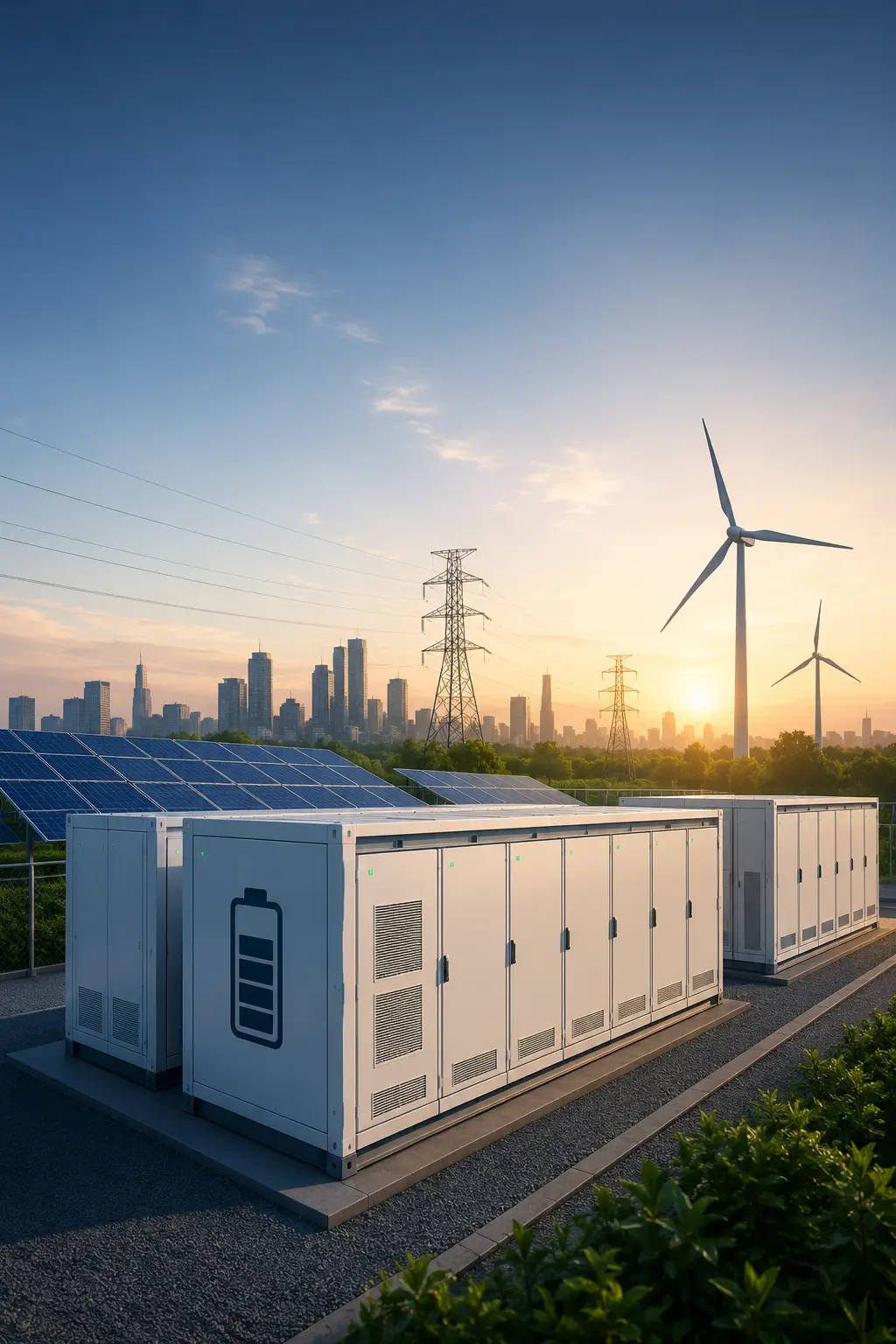
Executive Summary
India's Battery Energy Storage Systems (BESS) market is at a structural inflection point. The market is estimated at approximately US$1.5 billion in 2025, with projected expansion to US$7.5 billion by 2030 at a CAGR of 33 percent. Behind the headline number, three operational metrics confirm that the inflection has begun: cumulative installed BESS reached 341 MWh in 2024 (a sixfold increase from 51 MWh in 2023), the contracted project pipeline expanded to 92 GWh by end-2025 (up from 19 GWh a year earlier — a 384 percent jump), and 2025 saw 102 GWh of fresh tenders issued, a 35 percent increase over 2024. India is moving from a market characterised by tenders without commissioning to one where commissioning is now the binding constraint on growth, not policy or demand.
Three forces drive the trajectory through 2030. First, renewable integration economics are forcing storage onto the grid: India added approximately 24 GW of solar and 4 GW of wind in 2024–2025 against a target of 500 GW non-fossil fuel capacity by 2030, creating an irreversible structural need for firming, peak-shifting, and grid-stability services that storage uniquely supplies. Second, policy clarity and Viability Gap Funding (VGF) have transformed bankability: the VGF allocation expanded to 13.2 GWh in 2025 from 4 GWh initially, providing approximately 30 percent revenue support that compresses BESS payback periods to commercial viability and has driven competitive tariffs to INR 2.26 lakh per MW per month — a 4.6 percent decline from October 2024 to December 2024 alone. Third, scale players have entered: Reliance Industries secured 750 MW of RE+Storage capacity in Q4 2025, Adani announced a 1,126 MW / 3,530 MWh single-site BESS project for March 2026 commissioning, and ACME Solar, Tata Power, ReNew, JSW Energy, and Greenko collectively hold over 30 GW of contracted RE-plus-storage pipelines.
For investors, developers, and policymakers, the implication is that India's BESS market has moved from "if" to "when" — and the binding constraints are now execution speed, manufacturing scale-up under the PLI ACC scheme, and grid-integration capability rather than demand creation. The 2026–2027 commissioning cycle will be the defining operational test of the market's ability to convert pipeline into installed assets.
Market Overview
Definition and Scope
This report scopes the India BESS market as the full ecosystem of grid-connected and behind-the-meter battery storage systems — including utility-scale standalone BESS, BESS co-located with renewables (solar+storage hybrid, wind+storage), Firm and Dispatchable Renewable Energy (FDRE) and Round-the-Clock (RTC) projects with embedded storage, commercial and industrial (C&I) behind-the-meter installations, and EV-charging-station storage buffers. The scope captures hardware (battery packs, power conversion systems, balance of plant, EMS/BMS software), engineering and installation, operations and maintenance, and battery degradation/replacement provisions over a typical 15-year asset life. It excludes consumer-grade home batteries (residential energy storage is currently sub-1 percent of the market) and embedded storage in EVs themselves.
Evolution and Genesis
India's BESS market evolved through three distinct phases. The 2018–2022 period was the demonstration and pilot phase, characterised by sporadic small projects (typically 5–50 MWh) supported by state utilities and SECI tenders without dedicated financial structures — bankability was poor, tariffs were not commercially viable, and most awarded projects did not commission. The 2023–2024 period was the policy-foundation phase: the Cabinet approved the VGF scheme for 4 GWh of BESS in September 2023, the Energy Storage Obligation (ESO) was mandated under the Renewable Generation Obligation framework, and large RE+Storage tenders began landing in volume. India installed 341 MWh in 2024, primarily from policy-supported projects and behind-the-meter C&I deployments.
The 2025-onward phase is the scaled-deployment phase — characterised by VGF expansion to 13.2 GWh, tariff discovery to commercially viable levels (INR 2.26 lakh per MW per month for standalone BESS, sub-INR 4 per kWh for solar+BESS RTC tariffs), and scale players moving from tendering to construction. The market has moved past the "policy works" question and is now in the "execution at scale" phase.
Key Market Drivers
- Renewable energy integration imperative: India's 500 GW non-fossil fuel target by 2030 (currently approximately 220 GW deployed) requires approximately 47 GW of BESS capacity by 2032 per the National Electricity Plan, with the absence of which renewable curtailment is projected to exceed 8–12 percent of generation by 2027.
- Battery cost decline: Lithium-ion cell prices declined approximately 35 percent globally between 2022 and 2025, reaching US$80–95 per kWh for LFP cells. Indian project-level BESS pricing has compressed from approximately US$300/kWh (CAPEX, all-in) in 2022 to US$160–190/kWh in 2025.
- Policy support expansion: VGF allocation expanded from 4 GWh to 13.2 GWh in 2025; PLI ACC scheme allocates 50 GWh of domestic battery cell manufacturing (40 GWh awarded); PM Surya Ghar and state-level energy storage obligation (ESO) frameworks embed storage demand into the renewable mandate.
- Grid stability requirement: State load dispatch centres are increasingly mandating storage co-location with new renewable capacity above 100 MW, particularly in states with high RE penetration (Karnataka, Rajasthan, Gujarat, Tamil Nadu).
Macroeconomic and Regulatory Context
India's BESS market is operating against a power sector transitioning from coal-anchored baseload to renewable-anchored generation, with electricity demand growing at approximately 7–8 percent annually and peak load expected to exceed 270 GW by 2027. The combination of demand growth, renewable variability, and an aging coal fleet creates structural demand for flexibility services that storage uniquely provides. The macroeconomic context is also favourable: India's central bank-led credit environment supports renewable and storage project financing at competitive rates, and sovereign green bond issuance plus multilateral support (World Bank, ADB, IFC commitments exceeding US$5 billion to Indian RE-storage) provide concessional capital to bridge the bankability gap that VGF addresses.
Market Size & Growth Outlook
India BESS Market Size
Values shown in US$ billion (hardware, installation, software, services)
India BESS Market Size, Cumulative Capacity, and YoY Growth
| Year | Market Size (US$ B) | Cumulative Installed Capacity (GWh) | YoY Market Growth (%) |
|---|---|---|---|
| 2022 | 0.3 | 0.05 | — |
| 2023 | 0.6 | 0.10 | 100.0% |
| 2024 | 1.0 | 0.45 | 66.7% |
| 2025 | 1.5 | 0.95 | 50.0% |
| 2026 | 2.1 | 5.95 | 40.0% |
| 2027 | 2.9 | 13.0 | 38.1% |
| 2028 | 4.0 | 22.0 | 37.9% |
| 2029 | 5.5 | 33.0 | 37.5% |
| 2030 | 7.5 | 47.0 | 36.4% |
The market trajectory reflects three structurally distinct phases that map directly to underlying execution dynamics. Between 2022 and 2024, the market grew from US$0.3 billion to US$1.0 billion at an effective CAGR of 82 percent — but this masks the reality that cumulative installed capacity remained negligible (under 0.5 GWh) and most market value flowed into policy-foundation activities (tendering, regulatory framework development, pilot projects) rather than commissioning revenue.
The 2025 market value of US$1.5 billion reflects a transition: cumulative installed capacity reached approximately 0.95 GWh, the contracted pipeline grew to 92 GWh, and tariff discovery reached commercially viable levels. Crucially, 5 GWh of projects are expected to commission in 2026 — a step-change from the 0.5 GWh commissioned in 2025 — which will materially expand the operating revenue base of the sector.
The 2026–2030 trajectory projects the market scaling to US$7.5 billion at a CAGR of approximately 38 percent, with cumulative installed capacity reaching approximately 47 GWh by 2030. This forecast aligns directly with the Central Electricity Authority's National Electricity Plan target of 47 GW (47 GWh equivalent at typical 1-hour duration) of BESS by 2032, providing a policy-anchored demand baseline. The forecast assumes (a) execution of approximately 70–80 percent of the current contracted pipeline by 2030, (b) continued VGF availability for incremental rounds beyond 13.2 GWh, (c) PLI ACC manufacturing capacity reaching 25–30 GWh of operational cell production by 2028 (currently approximately 1.4 GWh commissioned), and (d) battery cost decline to US$60–70 per kWh for LFP cells globally.
A critical structural feature of India's BESS market is the divergence between value growth and capacity growth. Cumulative capacity is projected to grow at approximately 95 percent CAGR through 2030 — substantially faster than market value growth — because per-kWh pricing is declining at approximately 8–12 percent annually. This implies that the market will commission approximately 47 GWh of capacity by 2030 to support US$7.5 billion of value, versus approximately 0.95 GWh supporting US$1.5 billion in 2025. The implication for value capture is that volume players (large EPCs, integrated developers) will benefit disproportionately from scaling, while pure-play technology vendors face margin compression unless they differentiate on software, performance guarantees, or vertical integration into manufacturing.
Cumulative investment in India's BESS sector across 2025–2030 is expected to exceed US$22 billion, including approximately US$13 billion in project capex (47 GWh × ~US$280/kWh blended), US$5–6 billion in domestic manufacturing capacity expansion under PLI ACC and adjacent schemes, and US$3–4 billion in transmission and grid integration investment attributable to BESS deployment.
Market Segmentation
By Application
By Application
- Grid-Scale Standalone38%
- Renewable + Storage Hybrid30%
- Firm and Dispatchable RE (FDRE)17%
- C&I Behind-the-Meter9%
- EV Charging Buffer4%
- Residential2%
By Application
| Segment | Description | Share (%) |
|---|---|---|
| Grid-Scale Standalone | Standalone BESS providing capacity, ancillary services, peak shaving; supported by VGF; tariff INR 2.26 lakh per MW per month and below | 38% |
| Renewable + Storage Hybrid | Solar+BESS or wind+BESS co-located projects under SECI/state hybrid tenders; tariffs sub-INR 4 per kWh for RTC | 30% |
| Firm and Dispatchable RE (FDRE) | FDRE/RTC tenders with embedded storage; minimum 80–85% availability requirement; complex storage sizing | 17% |
| C&I Behind-the-Meter | Industrial captive consumption optimisation, peak demand reduction, time-of-day arbitrage | 9% |
| EV Charging Buffer | On-site storage at fast charging stations to manage demand charges and grid constraints | 4% |
| Residential | Solar rooftop coupled storage; small but growing under PM Surya Ghar Yojana | 2% |
Grid-scale standalone BESS dominates the application mix at approximately 38 percent, reflecting the focus of recent SECI and state utility tenders on standalone projects with VGF support. The structural advantage of standalone BESS is operational flexibility — the asset can monetise multiple revenue streams (capacity, ancillary services, energy arbitrage, peak power supply) under merchant or hybrid contracting, and is not tied to a single renewable generation profile. This segment benefits most directly from the VGF scheme and is where 2025–2026 commissioning will concentrate.
Renewable + storage hybrid (30 percent share) is structurally important because it represents the largest contracted pipeline (over 60 GWh of the 92 GWh total). Solar+BESS hybrid tenders have driven tariff discovery to commercially compelling levels — the lowest discovered tariff for solar+BESS reached INR 3.41 per kWh in December 2024 — at which point the technology becomes competitive with new coal generation and significantly cheaper than gas peaking. The implication for project economics is that solar+BESS at sub-INR 4/kWh represents a defensive bid against new coal capacity in tenders evaluated against levelised cost of energy.
Firm and Dispatchable Renewable Energy (FDRE) and Round-the-Clock (RTC) projects (17 percent share) are technically the most demanding application — requiring 80–85 percent annual availability that is achievable only with substantial storage backing (typically 4–8 hours of storage per MW of dispatchable capacity). FDRE/RTC tariffs cleared at approximately INR 4–5 per kWh in 2024 tenders, and the segment is structurally challenged by the trade-off between storage sizing (capex) and availability requirements (penalty risk). However, FDRE/RTC is the segment that most directly displaces coal baseload, and Indian utilities are increasingly tendering FDRE for state-level capacity additions.
C&I behind-the-meter BESS (9 percent share) is the highest-margin segment per kWh because it is procured on a project-economics basis (peak demand reduction, time-of-day arbitrage savings) rather than competitive tariff bidding. Industrial customers in states with high TOD differentials (Maharashtra, Tamil Nadu, Karnataka) are deploying BESS at IRRs of 14–18 percent against captive solar arrays. EV charging buffer storage (4 percent) is small but rapidly growing, particularly at high-power fast charging sites where demand charges can be 30–50 percent of operating costs without storage.
By Technology / Chemistry
By Technology / Chemistry
- Lithium-Ion (LFP)78%
- Lithium-Ion (NMC)14%
- Flow Batteries (Vanadium, Iron, Zinc)4%
- Sodium-Ion2%
- Other (Lead-acid, etc.)2%
By Technology / Chemistry
| Segment | Description | Share (%) |
|---|---|---|
| Lithium-Ion (LFP) | Lithium iron phosphate; standard for grid-scale due to safety, cycle life, cost; CATL, BYD, EVE, Hithium imports plus Indian assemblers | 78% |
| Lithium-Ion (NMC) | Higher energy density; declining share globally; retained for high-power density behind-the-meter and EV-charging applications | 14% |
| Flow Batteries | Vanadium redox, iron, zinc-air; suited for long-duration (8+ hour) applications; pilot deployments scaling | 4% |
| Sodium-Ion | Emerging chemistry; CATL commercial production from 2024; suitability for low-temperature India regions | 2% |
| Other | Lead-acid (legacy telecom, behind-the-meter), nickel-based; declining | 2% |
LFP dominates Indian BESS deployments at approximately 78 percent share, reflecting the global standardisation around LFP for grid-scale storage. The shift to LFP-dominance has been accelerated by three factors: superior safety profile (LFP is dramatically less prone to thermal runaway, a critical consideration for Indian project insurance and regulatory acceptance), lower cost per kWh (approximately 25–30 percent cheaper than NMC), and longer cycle life (typically 4,000–6,000 cycles vs 2,000–3,000 for NMC, supporting 15-year project lifecycles without battery replacement). NMC retains approximately 14 percent share, concentrated in C&I behind-the-meter and EV-charging-buffer applications where higher energy density justifies the cost premium.
Flow batteries (4 percent share) are an emerging but strategically important segment for long-duration storage applications. India has piloted vanadium redox and iron flow battery deployments for 8–12 hour storage applications (typically against off-peak solar charging for evening peak supply). The vanadium price volatility and supply chain concentration (China dominates vanadium processing) constrain near-term scaling, but iron-based flow battery technologies (ESS Inc., Form Energy) are increasingly being evaluated for India deployment with India-specific localisation discussions underway.
Sodium-ion batteries are the most strategically important emerging chemistry for Indian BESS. CATL launched commercial sodium-ion cells in 2024, and the technology offers lower cost (approximately 30–40 percent below LFP), better low-temperature performance (relevant for Northern Indian winter operations), and supply chain diversification away from lithium. By 2030, sodium-ion is expected to account for 8–12 percent of new Indian BESS deployments, particularly in Tier 2 cities and in lower-tier project economics.
By Project Size
By Project Size (Cumulative MWh installed)
- Large Utility (over 500 MWh)55%
- Mid-Scale (100–500 MWh)28%
- Small Utility (10–100 MWh)12%
- Distributed (under 10 MWh)5%
By Project Size
| Segment | Description | Share (%) |
|---|---|---|
| Large Utility (over 500 MWh) | Multi-GWh anchored projects; Reliance, Adani, Greenko mega-sites; project capex US$200–600M | 55% |
| Mid-Scale (100–500 MWh) | State utility tenders, RE+Storage hybrids; typical SECI standalone BESS award size | 28% |
| Small Utility (10–100 MWh) | DISCOM-led storage pilots, ancillary services projects; rapid growth post-2026 | 12% |
| Distributed (under 10 MWh) | C&I behind-the-meter, EV-charging-buffer, residential aggregations | 5% |
Large utility-scale projects dominate the BESS market at approximately 55 percent of installed capacity, reflecting the scale economics of grid-anchored deployments. Adani's announced 1,126 MW / 3,530 MWh single-site project (March 2026 commissioning) and Reliance's 750 MW Q4 2025 award are exemplary of the trend toward GWh-scale individual sites. The strategic logic is clear: large projects achieve substantially better unit economics (approximately 12–18 percent lower per-kWh cost than 100 MWh projects) due to fixed-cost amortisation, supply-chain volume discounts, and grid-connection capex efficiency. The forward implication is that the largest 5–10 sites by 2030 will likely account for 25–30 percent of total Indian BESS capacity.
Mid-scale projects (100–500 MWh, 28 percent share) represent the bulk of SECI and state-utility tender awards, typically sized around the standard tender block of 100 MW / 200–400 MWh. This segment provides the depth of competitive bidding that drives tariff discovery and is structurally important for the development of the EPC contractor and supplier ecosystem. Small utility projects (10–100 MWh, 12 percent share) are emerging in DISCOM-level deployments for distribution-side storage, particularly in states with renewable curtailment issues (Tamil Nadu, Karnataka, Gujarat).
By Region / State
By State (Project Pipeline Concentration)
By State (Project Pipeline Concentration)
| State | Description | Share (%) |
|---|---|---|
| Gujarat | GUVNL standalone BESS tenders, Khavda renewable park integration, BESS+RE hybrids | 22% |
| Rajasthan | Solar belt with high RE penetration; RVUNL tenders; Bikaner-Jaisalmer corridor concentration | 19% |
| Karnataka | Strong DISCOM commitment; KPTCL tenders; BESCOM behind-the-meter mandate | 14% |
| Maharashtra | MSEDCL hybrid tenders; C&I behind-the-meter strong (industrial concentration) | 11% |
| Tamil Nadu | TANTRANSCO storage tenders; chronic curtailment driving deployment | 10% |
| Andhra Pradesh | Hybrid renewable+storage projects; state-level RTC tendering | 8% |
| Madhya Pradesh | Rewa solar park integration; emerging BESS adoption | 6% |
| Others | Telangana, Punjab, Haryana, Uttar Pradesh, Northeast | 10% |
Gujarat leads with approximately 22 percent share of the BESS pipeline, reflecting GUVNL's aggressive standalone BESS tendering programme (the state secured the lowest VGF-supported tariff at INR 2.26 lakh per MW per month in December 2024) and the integration of storage with the Khavda renewable energy park (which is targeting 30 GW of solar+wind capacity). Gujarat's combination of strong state-level renewable mandates, a financially robust DISCOM (GUVNL), and concentrated RE generation creates the most favourable BESS development environment in India.
Rajasthan (19 percent share) anchors the second-largest state BESS pipeline, driven by extreme solar penetration in the Bikaner-Jaisalmer corridor and resulting curtailment pressures on the state grid. Renewable curtailment in Rajasthan exceeded 8 percent of solar generation during peak periods in 2024, creating direct economic justification for storage deployment. Karnataka (14 percent share) and Maharashtra (11 percent) follow, with Karnataka strong in DISCOM-led storage and Maharashtra dominated by C&I behind-the-meter applications driven by industrial concentration around Mumbai-Pune.
The next wave of state-level deployment is expected in Tamil Nadu, Andhra Pradesh, and Madhya Pradesh, each of which is actively tendering storage as part of their renewable integration strategy. The emerging frontier is the Northeast (Assam, Meghalaya, Sikkim) where storage is being evaluated for grid stability rather than RE integration, given the limited transmission infrastructure linking the region to the national grid.
By Storage Duration
By Storage Duration
- Short Duration (1–2 hours)18%
- Mid Duration (2–4 hours)56%
- Long Duration (4–8 hours)22%
- Ultra Long Duration (over 8 hours)4%
By Storage Duration
| Duration | Description | Share (%) |
|---|---|---|
| Short Duration (1–2 hours) | Frequency response, ancillary services, peak shaving | 18% |
| Mid Duration (2–4 hours) | Standard utility-scale; peak shifting, RE integration; majority of SECI/state tenders | 56% |
| Long Duration (4–8 hours) | FDRE/RTC support, evening peak supply post-solar; growing share | 22% |
| Ultra Long Duration (over 8 hours) | Multi-day storage; emerging applications; flow batteries and emerging chemistries | 4% |
Mid-duration storage (2–4 hours) accounts for approximately 56 percent of BESS capacity, reflecting the standard configuration of SECI and state utility tenders. The 2-hour duration is the most common single-block size because it aligns with peak shifting requirements (typically 2–3 hour evening peak in Indian states) and balances capex against revenue capture. The 4-hour duration is increasingly common for FDRE applications, where storage must support evening peak supply after solar generation declines.
Long-duration storage (4–8 hours, 22 percent share) is the highest-growth segment, expanding at approximately 50 percent CAGR. The structural driver is the increasing share of solar in Indian generation mix — as solar exceeds approximately 25 percent of state-level generation, the duration of stored energy required for evening peak supply extends from 2 hours to 4–6 hours. Karnataka, Tamil Nadu, and Rajasthan are leading the long-duration deployment trend. Ultra-long-duration storage (over 8 hours, 4 percent share) is currently a niche segment but represents the growth frontier for technologies such as iron flow batteries and zinc-air batteries that achieve cost-competitive economics only at 8+ hour durations.
Trends & Developments
VGF Expansion as the Primary Bankability Mechanism
The Viability Gap Funding (VGF) scheme has emerged as the single most important policy instrument enabling India's BESS market scale-up. Initial allocation of 4 GWh (September 2023) was expanded to 13.2 GWh in March 2025, with each MWh receiving approximately INR 6 lakh of capital subsidy (approximately 30 percent of project capex). The mechanism supports approximately 40 percent of the revenue gap that would otherwise prevent commercial bankability for standalone BESS, enabling competitive bidding at INR 2.26 lakh per MW per month. The strategic implication is that VGF has converted BESS from a "tendered but uncommitted" market into a commercially bankable one — and the 2026 commissioning wave is the operational test of whether the policy model translates to real assets at scale. The forward question is whether VGF will be extended to a third tranche (current allocation likely exhausted by mid-2026), with budget cycle decisions expected in 2026.
Tariff Compression and Solar+BESS Cost Parity
Indian BESS tariff discovery has compressed dramatically through 2024–2025. Standalone BESS tariffs fell to INR 2.26 lakh per MW per month (December 2024 GUVNL tender), a 4.6 percent decline from October 2024's INR 2.37 lakh, and reportedly approached INR 2.10 lakh in early 2025 SECI rounds. Solar+BESS hybrid tariffs reached INR 3.41 per kWh in December 2024 — competitive with new coal generation and structurally cheaper than gas peaking. The implication is that solar+BESS has crossed cost parity with thermal power for new capacity additions in major Indian markets, providing a structural alternative to coal expansion. Continued tariff compression is expected through 2026–2027 as battery cell prices decline another 15–20 percent and project execution efficiencies emerge.
PLI ACC Manufacturing Scale-Up Lagging Demand Growth
The Production Linked Incentive scheme for Advanced Chemistry Cell (ACC) batteries — with 50 GWh of allocated capacity (40 GWh awarded to Reliance, ACC Energy Storage, Ola Electric, and Rajesh Exports) — was designed to localise battery manufacturing and reduce import dependency. However, implementation is materially behind schedule: only 1.4 GWh (2.8 percent of the allocated 50 GWh) has been commissioned within stipulated timelines, all by Ola Electric. The implication is that India will remain heavily import-dependent for battery cells through at least 2027–2028, with cells imported from China (CATL, BYD, EVE Energy) and Korea (LG Energy Solution, Samsung SDI). The forward strategic question is whether the PLI delays trigger policy intervention (VGF for cell manufacturing, increased customs duties on imports, additional PLI rounds) or whether private capital (Tata Power's Agratas, Reliance's giga-scale plans) compensates outside the PLI framework.
Standalone BESS Surpassing Hybrid as Preferred Architecture
The 2024–2025 tender data shows a structural shift toward standalone BESS over RE+BESS hybrid configurations. Standalone BESS supports merchant operations, ancillary services, and multiple revenue streams that hybrid configurations cannot capture as effectively. The 2025 cumulative tender volumes show standalone BESS at approximately 38 percent of the pipeline, hybrid solar+BESS at approximately 30 percent, and FDRE/RTC at 17 percent — reversing the hybrid-dominant pattern of 2022–2023. The strategic implication is that BESS developers are increasingly prioritising standalone projects for revenue optionality, even though hybrid projects benefit from PPA contracting that simplifies financing.
Scale Player Entry and Capital Concentration
Reliance Industries (750 MW Q4 2025 award), Adani (1,126 MW / 3,530 MWh single-site by March 2026), Greenko (BESS plus pumped storage of approximately 17 GWh combined), Tata Power, ReNew, JSW Energy, and ACME Solar have collectively committed over US$15 billion to Indian BESS deployment through 2030. The capital concentration is consequential: the top 8 developers will control approximately 65–70 percent of cumulative BESS capacity by 2030, materially higher concentration than in solar (where Adani at 40.4 GW is the largest player but with ~20 percent share). The implication is that smaller pure-play BESS developers face structural pressure, with consolidation likely as smaller developers either are acquired or fail to scale.
Pumped Storage Hydropower Competition and Co-Existence
A defining feature of India's energy storage landscape is the parallel scaling of pumped storage hydropower (PSH) alongside BESS. The PSH pipeline reached 132 GWh by end-2025 (vs BESS at 92 GWh), and major developers (Greenko, Adani, JSW, NTPC) are pursuing PSH for long-duration applications where BESS economics are weaker. The strategic relationship between BESS and PSH is complementary rather than competitive: PSH dominates 8+ hour duration applications with lower per-kWh capex but higher project complexity, while BESS dominates short-to-mid-duration applications with faster execution. Both technologies are needed to support India's 500 GW non-fossil fuel target by 2030, and developers with portfolios across both (Greenko, Adani) are best positioned for the diverse storage demand.
Competitive Landscape
India BESS Competitive Landscape (Estimated Pipeline + Installed Share, 2025)
India BESS Competitive Landscape — Strategic Posture
| Company | Strategic Posture | Share (%) |
|---|---|---|
| Adani Group | Largest Indian RE developer (40+ GW); 1,126 MW / 3,530 MWh single-site BESS to commission March 2026; integrated with Khavda renewable park | 16% |
| Reliance Industries | 750 MW Q4 2025 RE+Storage award; integrated battery cell manufacturing strategy under PLI ACC (10 GWh allocation); aggressive scaling | 14% |
| Greenko | Leading pumped storage developer with parallel BESS portfolio; ArcelorMittal partnership for green steel applications; 17+ GWh combined storage pipeline | 11% |
| ACME Solar Holdings | 580 MW Q4 2025 RE+Storage award; FDRE/RTC focus; rapid ramp under SECI tenders | 10% |
| JSW Energy | 100 MW solar+100 MWh BESS BESCOM PPA; expanding standalone BESS portfolio; pumped storage parallel push | 9% |
| ReNew Energy Global | Established RE developer scaling into BESS; 22 GW installed RE; growing storage pipeline | 7% |
| NTPC Renewable Energy | PSU-led RE development; storage co-deployment with new RE capacity; 19.6 GW RE pipeline | 8% |
| Tata Power | Storage-coupled solar deployments; Agratas (Tata's battery manufacturing arm) supporting captive cell supply | 6% |
| Others | Hero Future Energies, Avaada Energy, Continuum Green Energy, Ayana Renewable, BluPine Energy, Serentica, plus C&I players (Amplus, Cleantech Solar, Fourth Partner) | 19% |
The competitive landscape resolves into four strategic archetypes that capture the structural forces. Conglomerate-anchored at scale (Adani Group, Reliance Industries, Tata Power) leverage existing renewable energy generation, transmission, and balance-sheet capacity to execute at extreme site sizes — Adani's 1,126 MW / 3,530 MWh single-site BESS at Khavda is the canonical example. Pure-play RE+storage developers (Greenko, ACME Solar, JSW Energy, ReNew Energy Global) compete on tendering execution, capital efficiency, and operational ramp speed; they hold the largest aggregate share but operate with thinner balance sheets and greater exposure to financing-rate volatility. PSU-led developers (NTPC Renewable Energy, NHPC, SJVN) execute storage co-deployment with new RE capacity under government tendering frameworks, capturing policy-aligned share but moving at slower decision cycles. Foreign cell suppliers and EPC partners (CATL, BYD, EVE Energy, Hithium from China, plus LG Energy Solution and Samsung SDI from South Korea, and emerging Indian assemblers under PLI ACC) supply the upstream cell layer — not direct project developers but structurally critical to project economics given over 90 percent import dependence on cells. The archetypes interact: Tata Power's Agratas vertical integration spans conglomerate and cell-supplier roles, and Reliance's PLI ACC participation positions it across developer and supplier archetypes.
The Indian BESS competitive landscape exhibits high concentration despite the early-stage nature of the market. The top eight players control approximately 81 percent of the contracted pipeline, a structurally higher concentration than in Indian solar (where the top eight control approximately 60 percent). The driver is capital intensity — large BESS projects require US$100–500 million of upfront capex, and the bankability requirements (track record, balance sheet, OEM relationships) favour developers with existing scale.
Adani Group (16 percent share) leads the market through its integration of BESS with the Khavda renewable energy park. The 1,126 MW / 3,530 MWh single-site BESS project (announced for March 2026 commissioning) is among the largest single-site BESS deployments globally and demonstrates Adani's capability to execute at extreme scale. Adani's competitive advantages are: (a) anchored to the Khavda 30 GW renewable park ensuring favourable site economics, (b) integrated transmission and substation capabilities reducing grid-connection delays, and (c) balance sheet capacity to absorb 24–30 month construction periods.
Reliance Industries (14 percent share) is rapidly scaling into BESS as part of a broader green energy strategy that includes battery cell manufacturing under PLI ACC (10 GWh allocation), gigafactory development at Jamnagar, and aggressive RE+Storage tendering. The 750 MW Q4 2025 award positions Reliance as the largest single-tender BESS developer, and the company's vertically integrated strategy (cell manufacturing → vehicle and grid storage assembly → project development) creates the most ambitious end-to-end BESS positioning in India.
Greenko (11 percent share) holds a unique position as the leading pumped storage developer, with cross-portfolio competence in PSH and BESS. The ArcelorMittal partnership for green steel storage applications creates differentiated commercial pipelines outside the standard utility-tender framework. Greenko's 17+ GWh combined storage pipeline (PSH plus BESS) positions it as the highest-capacity storage developer in India.
ACME Solar Holdings (10 percent share) emerged in 2024–2025 as an aggressive challenger, securing 580 MW of RE+Storage capacity in Q4 2025 and focusing on FDRE/RTC tenders. ACME's strategy combines competitive bidding with rapid execution, achieving construction timelines materially faster than peers.
JSW Energy (9 percent), ReNew (7 percent), NTPC (8 percent), and Tata Power (6 percent) collectively represent the second tier — established RE developers scaling into BESS as a natural portfolio extension. The strategic differentiation among these players is increasingly around cell sourcing (Tata's Agratas captive manufacturing vs. import-led JSW and ReNew), execution speed, and grid-integration competence.
The "Others" category at 19 percent share contains over 30 active developers, including emerging pure-play BESS specialists and C&I-focused players. Consolidation is expected as smaller developers without scale advantages or differentiated technology positioning find competitive bidding increasingly challenging. Foreign players (CATL, BYD, EVE Energy, Hithium) are present primarily as cell suppliers and EPC partners rather than direct project developers, though Tata Group's Tata Power Renewable Energy (with Agratas backing) is positioning to vertically integrate.
Challenges & Opportunities
Key Challenges
Pipeline-to-Commissioning Conversion Risk
The 92 GWh contracted BESS pipeline is the most important number in Indian energy storage — but converting it to operational assets is not guaranteed. Historical project execution rates in Indian renewables are approximately 65–75 percent (i.e., 25–35 percent of awarded projects do not achieve commissioning within timelines), and BESS projects face additional execution risks from battery cell supply chain dependencies (over 90 percent imported), grid-integration complexity, and engineering capability constraints (limited number of EPCs with BESS-specific experience). The implication is that 47 GWh by 2030 — the central forecast — assumes 60–70 percent execution rate, which is achievable but requires improvement in execution capability across the ecosystem. The downside scenario (50 percent execution rate) would limit cumulative installed capacity to 35–40 GWh by 2030, reducing market value by 15–20 percent.
Battery Cell Supply Chain Dependence
India imports approximately 90+ percent of lithium-ion battery cells, predominantly from China (CATL, BYD, EVE Energy, Hithium) with growing supply from South Korea (LG Energy Solution, Samsung SDI). The PLI ACC scheme — designed to address this dependency — is materially behind schedule, with only 1.4 GWh of the 50 GWh target commissioned within the original timelines. The implication is that India remains exposed to cell supply chain risk through at least 2027–2028, with potential disruption from China-India trade tensions, customs duty changes, or upstream raw material constraints (lithium, graphite, cobalt). The forward risk is that BESS execution timelines extend or costs increase if cell imports are constrained, with disproportionate impact on smaller developers without long-term supply agreements.
Tariff Race-to-the-Bottom Risk
Aggressive competitive bidding has compressed BESS tariffs to commercially viable but increasingly tight margins. The standalone BESS tariff at INR 2.26 lakh per MW per month (December 2024) translates to approximately 10–12 percent project IRR at current capex assumptions — sustainable for well-executed projects but vulnerable to construction cost overruns, financing rate increases, or cell price volatility. The implication is that 2024–2025 awarded projects are operating with thin economic margins, and developers without the operational excellence to execute at or below benchmark capex face profitability risk. The structural concern is that continued aggressive bidding could erode developer returns to levels that reduce future participation, slowing the medium-term market.
Grid Integration and Transmission Bottlenecks
BESS deployment at scale requires grid connection infrastructure that is itself capacity-constrained in many Indian states. Inter-state transmission constraints are particularly binding in Karnataka, Tamil Nadu, and parts of Rajasthan, where renewable curtailment is already an issue. CTU (Central Transmission Utility) approvals for new connections can take 18–30 months, materially extending project timelines. The implication is that BESS execution is coupled to transmission upgrade execution, and the combined critical path from financial close to commissioning extends to 30–48 months for grid-anchored projects in constrained regions. The forward solution requires synchronised CEA-CERC-CTU planning that has historically been challenging to achieve.
Key Opportunities
Renewable Curtailment Reduction as Direct Economic Justification
Indian renewable curtailment exceeded 8 percent of solar generation in Rajasthan and Karnataka in 2024, representing approximately US$300–400 million of foregone generation revenue annually. BESS deployment directly captures this curtailed energy at near-zero marginal cost, providing economic returns separate from any policy support. The implication is that approximately 15–20 GWh of BESS capacity can be deployed purely on curtailment-arbitrage economics in high-RE-penetration states, providing a structural floor of demand independent of VGF or policy support. This dynamic is particularly important for state-utility-led storage tenders that increasingly include curtailment-mitigation revenue streams.
Domestic Manufacturing Scale-Up and Supply Chain Localisation
Despite PLI ACC delays, the long-term trajectory toward domestic battery manufacturing is structurally favourable. Tata Group's Agratas (announced 60 GWh facility in Sanand, Gujarat), Reliance's giga-scale strategy at Jamnagar, and emerging players (Exicom, Lohum, Indian assemblers of imported cells) collectively represent over 100 GWh of announced manufacturing capacity beyond PLI ACC allocations. The implication is that India is likely to achieve 30–50 GWh of domestic cell manufacturing by 2030, materially reducing import dependency and creating cost advantages of 10–15 percent vs. imported cells (after duties, logistics, and inventory holding). The opportunity for investors is in cell manufacturing equity, in raw material processing (lithium refining, cathode/anode materials), and in adjacent battery industries (BMS software, fire safety systems, recycling).
C&I Behind-the-Meter as High-Margin Growth
The C&I behind-the-meter segment offers the highest unit-economics in Indian BESS — IRRs of 14–18 percent (vs. 10–12 percent for utility-scale) supported by industrial customers' willingness to pay for peak demand reduction, time-of-day arbitrage, and resilience. Industrial states with high TOD differentials (Maharashtra, Tamil Nadu, Karnataka) are the immediate addressable market, and the segment is expected to grow at approximately 50 percent CAGR through 2030 — materially faster than the overall market. Pure-play C&I developers (Amplus Solar, Cleantech Solar, Fourth Partner Energy, Vibrant Energy, BluePine Energy, Sterling and Wilson) are scaling rapidly, and the opportunity for grid-tied developers is to extend portfolios into C&I as the higher-margin segment.
Long-Duration Storage Market Emergence
As Indian solar penetration approaches 30 percent of state-level generation in leading states, the duration of stored energy required for evening peak supply extends beyond 4 hours, creating a long-duration storage opportunity that is currently underserved. The technical solutions — flow batteries (vanadium, iron, zinc), thermal storage, hydrogen-coupled storage — have higher per-kWh capex than 2-hour LFP but materially lower per-kWh-cycle costs at 8+ hour durations. India is positioned as one of the largest addressable markets for long-duration storage globally, and the first-mover developers in this segment (currently piloting 10–50 MWh demonstration projects) will define the competitive structure as the market scales toward 5–10 GWh by 2030.
Key Policies & Regulatory Environment
Viability Gap Funding (VGF) Scheme for BESS
The VGF scheme for standalone BESS, approved by the Cabinet in September 2023 with an initial allocation of 4 GWh, was expanded to 13.2 GWh in March 2025 — a more-than-tripling of allocated capacity. The scheme provides up to INR 6 lakh per MWh of capital subsidy (approximately 30 percent of project capex), supplementing competitive tariffs to achieve commercial bankability. The mechanism has driven tariff discovery to INR 2.26 lakh per MW per month (December 2024) — sub-INR 0.50/kWh on a per-energy-throughput basis, materially below diesel peaking and competitive with combined-cycle gas. The forward question is whether VGF will be extended to a third tranche (current allocation likely exhausted by mid-2026) and whether the per-MWh subsidy will be reduced as projects achieve commercial viability without subsidy support.
Production Linked Incentive (PLI) Scheme for Advanced Chemistry Cell (ACC)
The PLI ACC scheme, with an outlay of approximately INR 18,100 crore (US$2.2 billion), targets 50 GWh of domestic ACC battery manufacturing capacity. Initial 50 GWh was allocated through bidding — 40 GWh awarded across four firms (Reliance, Ola Electric, ACC Energy Storage, Rajesh Exports), with the remaining 10 GWh allocated in a second round to Reliance's subsidiary. The scheme provides subsidies for incremental cell sales over a 5-year period, structured to reward operational manufacturing volume rather than just installed capacity. Implementation is materially behind schedule — only 1.4 GWh (2.8 percent) of allocated capacity has been commissioned within stipulated timelines. The implication is that domestic manufacturing capacity will lag demand growth through at least 2027–2028, sustaining import dependency but creating opportunity for additional PLI rounds or alternative incentive structures.
Energy Storage Obligation (ESO)
The Energy Storage Obligation, introduced as a complementary mechanism to the Renewable Generation Obligation, mandates that DISCOMs procure a specified percentage of their RE generation paired with storage. The ESO target rises from 1.0 percent of total power consumption in FY2024 to 4.0 percent by FY2030. The mechanism creates a structural floor of storage demand from DISCOMs, complementing the supply-side support of VGF. Implementation enforcement varies by state, with proactive states (Karnataka, Gujarat, Maharashtra) actively contracting storage to meet ESO requirements, while less proactive states are accumulating compliance shortfalls that may trigger penalty mechanisms or retroactive procurement.
National Electricity Plan and 47 GW BESS Target
The National Electricity Plan 2032 (CEA), released in 2023 and updated in 2025, formally established a target of 47 GW of BESS and 27 GW of pumped storage hydropower by 2032. The targets are anchored to the 500 GW non-fossil fuel target by 2030, with storage required to manage the variability of approximately 350 GW of solar+wind generation. The plan creates policy-anchored demand visibility extending to 2032 and provides the regulatory framework for state-level capacity addition planning. The implication is that storage is now treated as essential grid infrastructure rather than optional generation supplement, embedding storage demand into the long-term power planning framework.
Custom Duty Exemption for Battery Cells
Battery cells imported for grid storage applications benefit from concessional customs duties (currently 5 percent versus 30+ percent for unrelated lithium-ion products). The exemption supports project economics during the import-dependency phase but creates a structural disincentive for early domestic manufacturing investment unless paired with PLI subsidies. The forward expectation is that customs duties will rise once domestic manufacturing capacity scales — likely 2027–2028 — as a complementary mechanism to incentivise localised production.
Battery Waste Management Rules
The Battery Waste Management Rules (effective 2022, amended 2024) establish extended producer responsibility for end-of-life batteries, with mandated recycling targets and material recovery rate requirements rising over time. For BESS specifically, the rules establish recycling network requirements, refurbishment standards for second-life applications, and battery passport tracking. The framework supports approximately 5–10 GWh of cumulative end-of-life BESS battery flow expected through 2032, creating a US$2–4 billion battery recycling and second-life industry. The implication is that vertically-integrated developers (Tata, Reliance, Adani) capture additional value from battery recycling that pure-play developers cannot.
State-Level Renewable + Storage Mandates
Several states (Gujarat, Karnataka, Tamil Nadu, Maharashtra, Rajasthan) have introduced state-level mandates requiring co-location of storage with new renewable capacity above 100 MW. The mandates vary by state but typically require 20–30 percent of MW capacity backed by storage, with duration requirements of 2–4 hours. The implication is that storage demand is increasingly being driven by state-level rather than central-level policy, with implications for the structural geography of deployment — states with proactive renewable+storage mandates capture disproportionate share of new project pipeline.
Future Outlook
India's BESS market is entering a structurally transformative phase between 2026 and 2030 that will reshape the country's power sector. Three transitions define the outlook.
The first is the transition from pipeline to commissioning at scale. The 92 GWh contracted pipeline at end-2025 represents the highest concentration of contracted but uncommissioned storage capacity globally as a share of installed capacity. The 2026 commissioning wave (5 GWh expected) is the operational test of the market's ability to convert pipeline into assets. By 2030, cumulative installed capacity is projected to reach approximately 47 GWh, requiring an average commissioning rate of approximately 9 GWh annually between 2027 and 2030 — a step-change from the 0.5 GWh commissioned in 2025. The execution constraints (cell supply, EPC capacity, grid connection) are the binding determinants of whether the central forecast is achieved or whether the trajectory underperforms.
The second transition is the migration from policy-supported bankability to commercial bankability. Current BESS economics depend materially on VGF (30 percent capital subsidy), customs duty concessions on cell imports, and competitive tariff floors maintained by limited supply. By 2028–2029, battery cell prices declining to US$60–70/kWh (LFP), expanding domestic manufacturing reducing logistics and inventory costs, and increasing operational track records reducing perceived execution risk should collectively enable BESS economics that are commercially bankable without policy support. The implication is that VGF and similar support mechanisms will likely phase down post-2027 (similar to the solar subsidy phase-out trajectory of 2014–2018), with BESS continuing to scale on the back of underlying economics rather than policy-driven economics.
The third transition is the emergence of multi-revenue stream BESS operations as the dominant commercial model. Current Indian BESS projects are predominantly contracted on capacity-payment models (INR per MW per month) with limited operational flexibility. As the market matures and ancillary services markets develop (frequency response, reserves, voltage support, black-start), BESS operators will increasingly stack multiple revenue streams: capacity payments, energy arbitrage, ancillary services, and eventually capacity firming services. The Central Electricity Regulatory Commission (CERC) market reforms in 2024–2025 — particularly the introduction of Real-Time Market and emerging ancillary services markets — provide the foundation for multi-revenue stream optimisation. By 2030, sophisticated BESS operators will likely capture 1.5–2.0× the per-kWh revenue of single-purpose BESS through multi-stream optimisation.
Geographically, deployment will remain anchored in Gujarat, Rajasthan, Karnataka, Maharashtra, and Tamil Nadu, with these five states accounting for approximately 75 percent of cumulative BESS capacity by 2030. However, emerging deployment in Andhra Pradesh, Madhya Pradesh, and the Northeast will diversify the geographic distribution, with implications for inter-state transmission planning and project execution complexity.
The competitive landscape is expected to consolidate further. The top eight developers control approximately 81 percent of pipeline today and are expected to control 75–80 percent of installed capacity by 2030, with further consolidation among smaller developers and the entry of foreign cell-manufacturer-led consortia (CATL, BYD, EVE Energy partnering with Indian developers for vertically integrated supply). Pure-play BESS specialists without scale or differentiated technology positioning face structural pressure.
Cumulative investment across 2025–2030 is expected to exceed US$22 billion, supporting approximately 47 GWh of capacity, US$5–6 billion in domestic manufacturing capacity, and US$3–4 billion in attributable transmission infrastructure. The investment trajectory is supported by sovereign green bonds, multilateral institution support (World Bank, ADB, IFC commitments exceeding US$5 billion), and increasing private capital (private equity, sovereign wealth funds, insurance company allocations).
The principal risk to this outlook is slower-than-expected execution of the contracted pipeline due to cell supply constraints, EPC capacity bottlenecks, grid connection delays, or financial closure issues. A scenario in which only 50 percent of the contracted pipeline is commissioned by 2030 would limit cumulative installed capacity to approximately 35 GWh, with disproportionate impact on the 2027–2028 commissioning years and on developers with thin balance sheets. However, even in this downside, the structural drivers — renewable integration imperative, declining cell costs, policy support — would continue to scale BESS demand, with execution constraints triggering policy or market response (additional incentives, foreign developer access, accelerated transmission build-out).
For tailored support and detailed market analysis, see our offerings on Services or Contact Us.
Contact
Email: sales@aloraadvisory.com
Phone: +353 87 457 1343 | +91 704 542 4192
Frequently Asked Questions
What is the current size of India's BESS market?
Approximately US$1.5 billion in 2025, with cumulative installed capacity of approximately 0.95 GWh and a contracted pipeline of 92 GWh.
What is the expected growth rate through 2030?
A CAGR of approximately 33–38 percent between 2025 and 2030, reaching approximately US$7.5 billion. Cumulative installed capacity is projected to reach 47 GWh by 2030, aligned with the National Electricity Plan target.
Which segment dominates the market?
By application, grid-scale standalone BESS at approximately 38 percent share leads, followed by renewable+storage hybrid at 30 percent. By technology, LFP lithium-ion accounts for approximately 78 percent of installations.
Who are the leading players?
Adani Group (16 percent), Reliance Industries (14 percent), Greenko (11 percent), ACME Solar (10 percent), JSW Energy (9 percent), NTPC (8 percent), ReNew Energy (7 percent), and Tata Power (6 percent) collectively control approximately 81 percent of the contracted pipeline.
What is the Viability Gap Funding scheme?
The VGF scheme provides approximately 30 percent capital subsidy (INR 6 lakh per MWh) to standalone BESS projects, with current allocation of 13.2 GWh (expanded from 4 GWh in 2023). It has driven tariff discovery to commercially viable levels, with the lowest standalone BESS tariff reaching INR 2.26 lakh per MW per month in December 2024.
What is the PLI ACC scheme and its progress?
The Production Linked Incentive scheme for Advanced Chemistry Cell (ACC) batteries targets 50 GWh of domestic manufacturing with INR 18,100 crore (US$2.2 billion) of incentives. As of October 2025, only 1.4 GWh (2.8 percent of allocated capacity) has been commissioned, materially behind original timelines.
What are the biggest challenges?
Pipeline-to-commissioning conversion risk (historical execution rates 65–75 percent), battery cell supply chain dependence (90+ percent imports), tariff race-to-the-bottom compressing margins, and grid integration / transmission bottlenecks in high-RE-penetration states.
About Us
Alora Advisory is a market research and strategic advisory firm that helps organizations make confident, evidence led decisions in uncertain environments. It combines rigorous research with strategic interpretation to deliver decision ready market intelligence across growth, competition, and investment priorities.